


List of manufacturers Hungary
| Manufacturers by alphabet | Model count | Models with | Total |  |
|||||||||
|---|---|---|---|---|---|---|---|---|---|---|---|---|---|
| Total | <1930 | >1942 |  |
 |
 |
 |
 |
|
|
||||
 | |||||||||||||
 |
123 | 0 | 25 | 103 | 5 | 5 | 56 | 241 | 7 | 1 | ||||
|
338 | 0 | 338 | 317 | 122 | 121 | 30 | 104 | 1873 | 439 | 2 | |||
|
119 | 0 | 1 | 34 | 118 | 35 | 35 | 38 | 1 | 445 | 58 | 2 | ||
|
225 | 0 | 225 | 218 | 97 | 97 | 2 | 608 | 157 | 1 | ||||
|
426 | 0 | 426 | 381 | 32 | 32 | 147 | 192 | 2250 | 227 | 2 | |||
|
147 | 0 | 147 | 126 | 12 | 12 | 30 | 61 | 768 | 58 | 1 | |||
|
133 | 0 | 130 | 132 | 281 | 2 | 2 | |||||||
|
162 | 0 | 162 | 142 | 10 | 10 | 18 | 97 | 664 | 50 | 1 | |||
|
1029 | 13 | 46 | 685 | 876 | 397 | 384 | 630 | 185 | 6218 | 883 | 4 | ||
|
227 | 0 | 37 | 74 | 218 | 132 | 126 | 153 | 29 | 1281 | 231 | 4 | ||
|
156 | 0 | 14 | 22 | 147 | 88 | 88 | 112 | 1093 | 129 | 4 | |||
|
218 | 0 | 89 | 91 | 203 | 55 | 51 | 120 | 19 | 1298 | 82 | 4 | ||
|
104 | 0 | 6 | 95 | 319 | 1 | ||||||||
|
699 | 0 | 699 | 650 | 192 | 183 | 266 | 251 | 4384 | 761 | 2 | |||
Text/Pictures for Hungary
Radio Factories and Radio Production in Hungary
Text of the member Sandor Selyem-Tóth, Hungary
In 1917-18 the production of military radio transceiver (KLERA) started at the Telefongyár (Telephone Factory) with using electron tubes produced by Egyesült Izzó; but from 1925 radios produced in Izzó and in the manufacturing co-operation were put into circulation under TUNGSRAM brand.
Manufacturing sets for non-military purpose started at Telefongyár in 1923 and till the middle of the 1930s sets were made on the basis of Telefunken licence. From the 1950s the factory also produced military telecommunicational sets again.
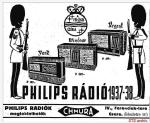
The Hungarian interest of PHILIPS started manufacturing radios in 1931 and beside ORION it was one of the most significant manufacturer until the end of World War II.
The Magyar Wolframlámpagyár (The Hungarian Wolfram Lamp Factory) appeared under ORION brand and began manufacturing in 1925 and it meant a determining productive capacity from the beginning of the 1930s. In the 30s it exported sets under Tungsram brand.
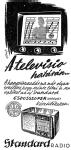
The Standard Villamossági RT (interests of ITT in Hungary) which was formed from a department of Egyesült Izzó, was a determinant firm too. It did wage labour to more firms (EKA, Philips, Telefunken).
Siemens has been present on the home market only from 1941 but till the end of the war it produced sets in great amount. Until 1950 these sets were put into circulation with VIKERT brand on them.
It's important to mention the Néprádió (Public Radio) campaign, which was carried out by the collaboration of four factories (ORION, Philips, Telefunken and Standard)
On the basis of prior assessment of demands more than 120 thousand of sets were claimed, but only 45 thousand pieces were made because printing sets wasn't a good deal. In great amount public radios were manufactured again from 1950.
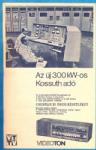
Most of the factories closed down or were transformed, or they changed their outline on the well-known political grounds. As a significant factory the Vadásztölténygyár, later as Videoton, can be mentioned from 1955
Beside the mentioned plants in the Golden Age at least 30 smaller or bigger factories, smaller enterprises were present on the market, some of them only for 1 or 2 years, but their radios can be found at the collectors.
The most well-known ones were the following:
Süss Nándor RT. 1900-1990
EKA (Engel Károly, a cég 1926-tól) 1934-1947
ERICSSON Magyar Villamossági RT 1924-1926
Astra Villamossági és Rádió Mûvek 1929-1931
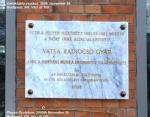
Vatea 1930-1933
Rikert Rádió 1930-1932
BAPO (Barta és Társa) 1926-1938
Belgráder Rádió 1930-1941
B.J. (Bodnár Jenõ) 1931-1938
Reich Rádió (Reich Miklós) 1930-1932
SZIKSZ Rádió 1931-1933
Rádiócentrum (Miklós Dezsõ) 1933-1936
Rotand (Rotter Lóránd) 1933-1938
Phöbus Villamos Mûvek 1934-1938
AMRAD (Hidy és Társa) 1935-1936
ECHO (Vörös Rezsõ, Lamoth Emil) 1938-1948
Fénycsõ K.SZ. 1956-1957
Beloiannisz (BHG) 1955-1956
Finommechanikai Vállalat (Székesfehérvár) 1960-1966
Fõvárosi Finommechanikai Vállalat 1956-1957
Perfekt Rádió 1936-1937
Urner és Berkovits 1926-1927
RÁVA (Rádiótechnikai Vállalat) 1950-?
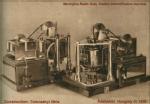
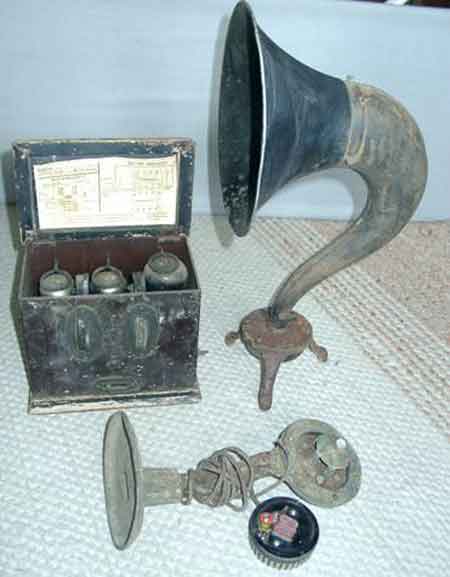
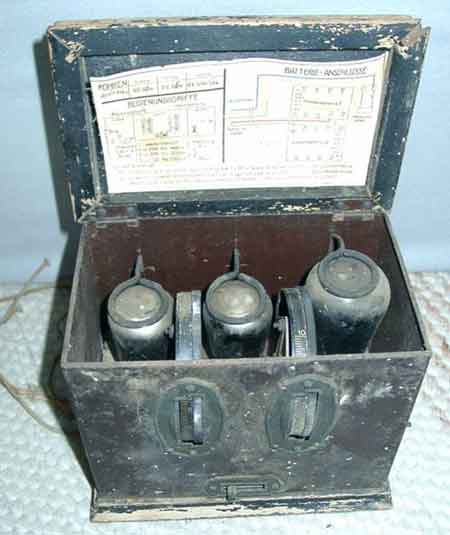
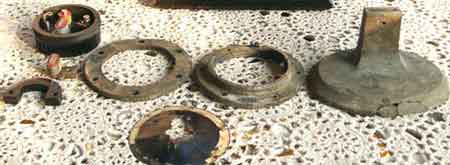
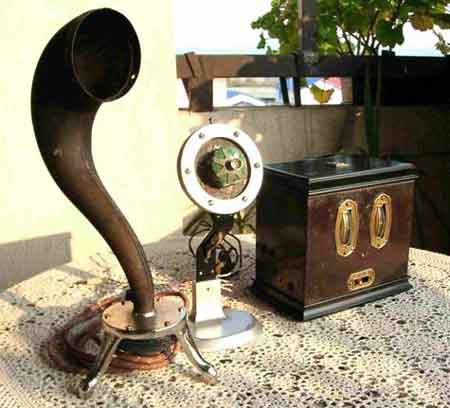
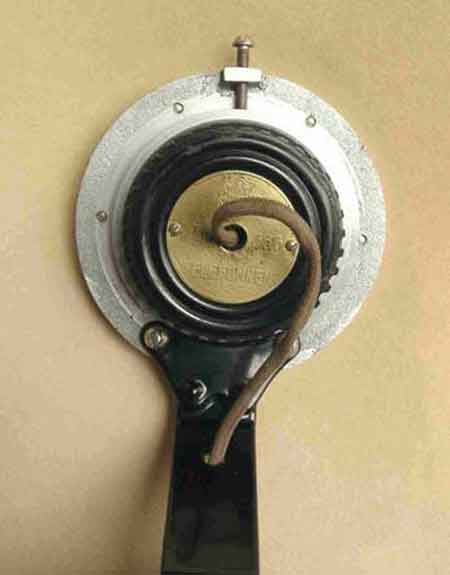
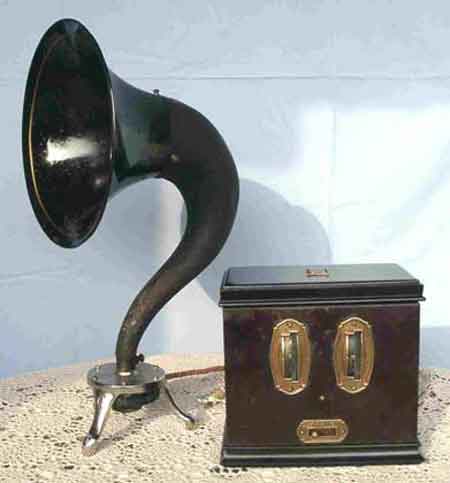
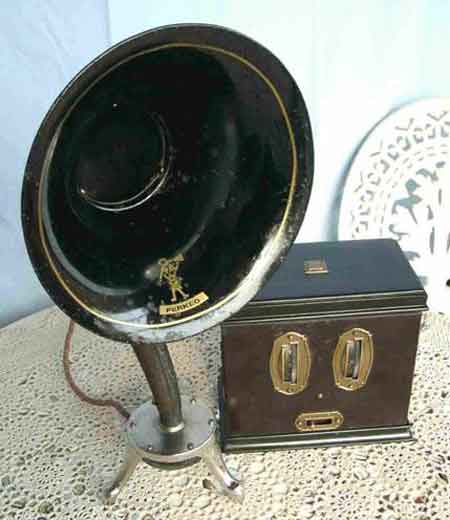
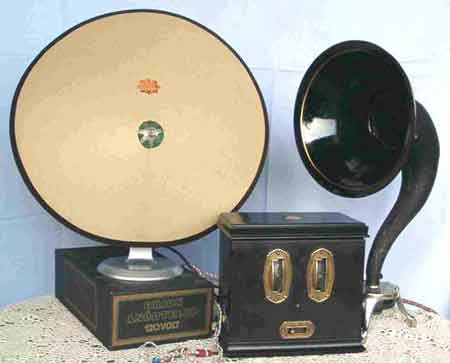
I found an interesting document in the company brochure of "Tungsram". On two separate photos you can clearly see that they are assembling and checking the equipment We 3B, that was manufactured between 1924-26. Unfortunately the editor added the text to one of them saying it shows telephone assembly, which is obviously erroneous. Next to the We 3B you can clearly see the antenna and the funnel speaker.
Information about Hungarian Radio
Hungary compared to its population has already given a lot of Nobel prize scientists to the world. Unfortunately we did not have any great people in connection with the radio like other nations, Popov, Marconi, Tesla, Lee de Forest and the others. But we have to mention Tivadar Puskás by all means, who put the first telephone exchange in the world into operation in Paris in April 1879, then in 1892 the "Telefonhírmondó" (a wired news and announcer apparatus) in Pest. There was another very important invention in 1892, it was Antal Pollák and József Virág's quick telegraphic apparatus, which was able to work at 100,000 word/hour data-transfer speed and it counted a great achievement compared to the level of that age. In connection with television many Hungarian scientists played an important role, but let's drop the matter, it's another story.
Without being exhaustive I would like bring to mind some dates of events happened in Hungary in order to make it possible to every inquirer to be able to form a notion of technological history in Hungary:
1903. the first experiments with Slaby-system spark transmitter between Weiss Manfred and the Egyesült Izzólámpagyár in Csepel
1904-1906. experiments between the coast in Fiume and the moving station of "Előre" ("Forward") ship on the Adriatic
1914. a telegraphic station was put into operation in Csepel
1923. radiotelephone experiments with the 5kW telegraph transmitter
1923-24. experiments with the 250W Huth transmitter
1925. the 2kW Telefunken transmitter was installed (with 500W broadcasting operation)
1927. the 3kW Telefunken transmitter was installed (with 750W broadcasting operation)
1928. the Telefunken transmitter with 20kW broadcasting capacity was installed and on the 1st April the midday peal of bells was broadcast through the radio
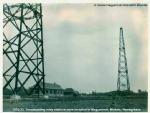
1932-33. broadcasting relay stations were installed in Magyaróvár, Miskolc, Nyíregyháza and in Pécs
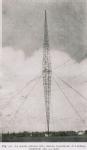
1933. installing the 120kW Lakihegy transmitter, a radio antenna was made, which was the highest in the world of that time, the height is: 314 m.
1957. the first FM broadcast was the newest event
It's very instructive to look over the changes in the number of the radio subscribers, see as following:
- in December 1925 17.072 subscribers
- in December 1926 56.383 subscribers
- in 1928. 162.000 subscribers, among these 105,000 pieces with detector
- in 1931. 307.000 subscribers, among them 183,000 pieces with detector
- in 1935. 352.902 subscribers
- in 1940. 499.368 subscribers, among them 66,638 pieces with detector
- in 1961. 2.002.500 subscribers, and 240,000 wired subscribers
- in 1969. 2.531.000 subscribers
To give you a foretaste here are some data about the development and strength of the Hungarian radio industry.
In 1935 the radio set export got more than 50% from the electrical industry export, which was 31.5 million pengo
In 1939 beside the radio set and component import - 984 thousand pengo - the export was 3,561,000 pengo.
The success of the home electron tube manufacturing was more amazing, because in that year beside the imported 6,104 receiver and 105 transmitter tubes, 2,031,466 receiver and 2,126 transmitter were exported.
World War II strongly retarded the production but from the middle of the 1950s it became an important export factor again.
Manufactured Sets
(pcs) Export
(pcs)
- 1956. 352.291 106.144
- 1957. 454.183 184.464
- 1958. 453.290 221.824
- 1959. 263.534 112.880
Of course, beside the level of the industry, the media and publishing of books that increase the knowledge of radio friends and inquirers was as high as all over in Europe.
The most significant radio newspapers were the following:
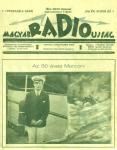
Magyar Rádió Újság (Hungarian Radio Newspaper) May1924 -1928.
Rádió Amatőr (Radio Amateur) 1926- October 1930
Rádió és Fotó Amatőr (Radio and Photo Amateur) November 1930. - 1933.
Rádió Technika (Radio Technology) March 1936. - August1948. augusztus
(stopped between June 1944 to August 1947)
Rádióvilág (Radio World) Jahuar 1946. - August 1948.
Rádió és Filmtechnika (Radio and Film Technology) September 1948. - October 1951.
Of course, Hungarians read foreign papers too and a good example for this is that among the 60 readers' letter in ÖRA, the Austrian amateur radio paper (no. 12/1927), 5 letters were Hungarian, and the question (about anode deputies) of a reader from Kaposvár was also published.
Here I have to mention Károly Kemény , mechanical engineer's article (in the Rádió és Fotó Amatör no. December/1930, page 1. 2. 3. ) in which he drafted the idea of an amplifier part with illustrations, and was carried out by American scientists as a transistor in 1948.
Finally I would like to offer some books and publications to those are interested:
Jenő Mende: A drótnélküli telegráfia (1921)
János Molnár: Gyakorlati Rádiókönyv (1926)
János Molnár: Anódpotlók építése és kezelése (1929)
A 10 éves Magyar Rádió (1935)
István Horváth: Rádió Compass (1938 - 1943)
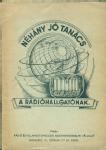
Tungsram: Rádió Tanácsadó (1944)
15 év Standard rádió (1944)
Rádió évkönyv (Tivadar Kiss as an editor 1947 - 1949)
Géza Kádár: Rádiókészülékek kapcsolásai (1956) and any other books from him.
Text in other languages













|
Hits: 6839 Replies: 0
Hungary (H)
|
||
|
Sándor Selyem-Tóth
21.Mar.09 |
1
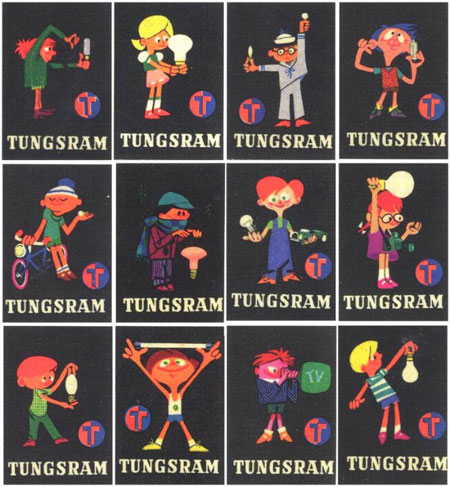
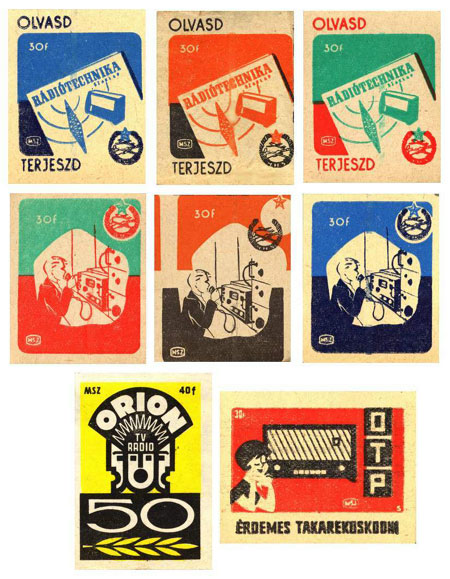
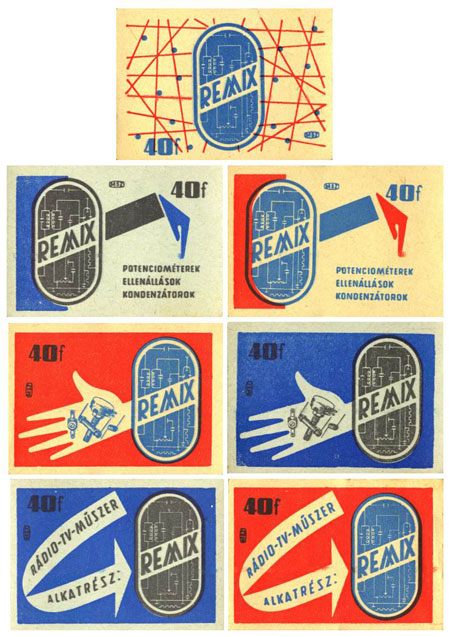
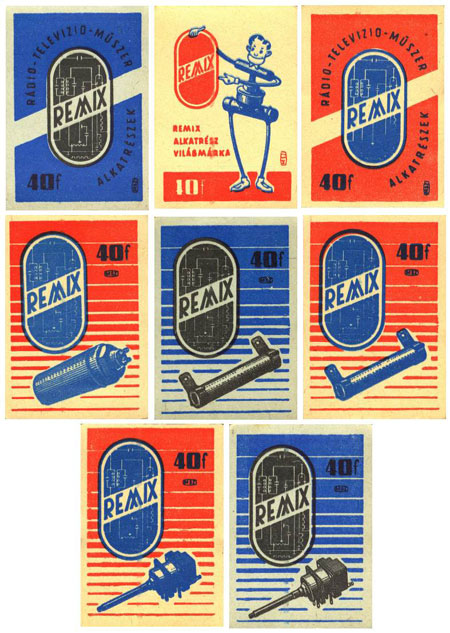
Radio Spare Parts and Other Trivia on Matchbox Labels
|
|
|
Hits: 6478 Replies: 0
Hungary (H)
|
|||
|
Sándor Selyem-Tóth
21.Mar.09 |
1
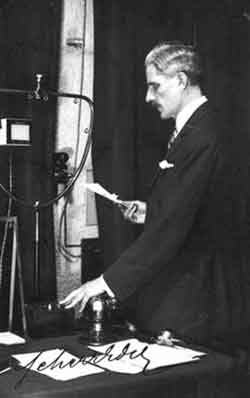
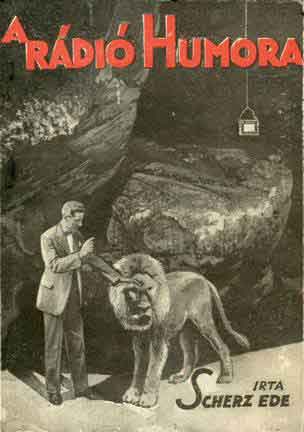
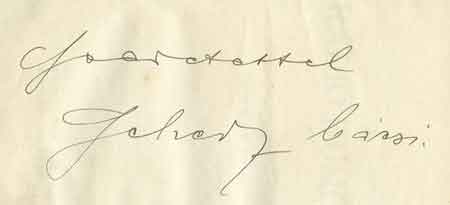
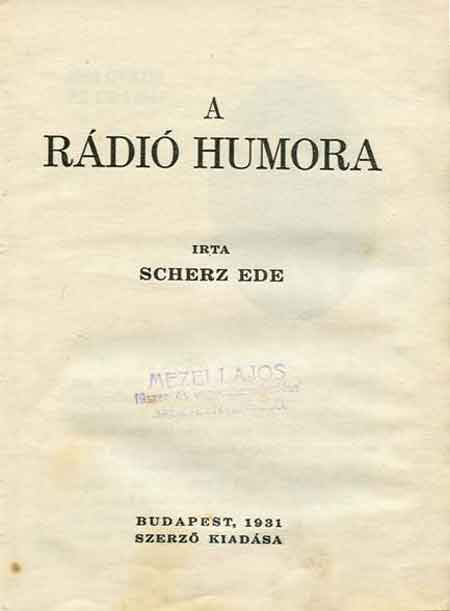
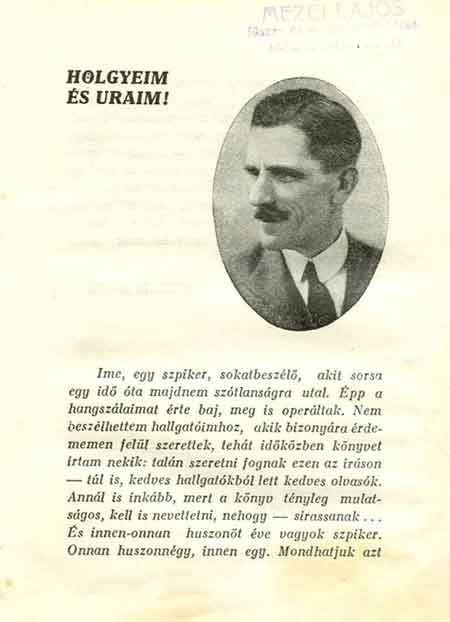
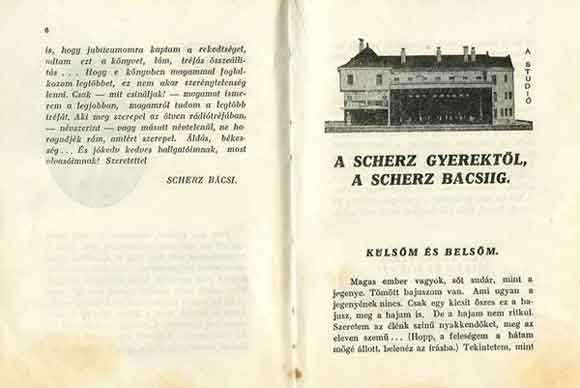
Who was the legendary Uncle Scherz?
|
||
|
Hits: 6275 Replies: 0
Hungary (H)
|
||
|
Sándor Selyem-Tóth
21.Mar.09 |
1
Who was the legendary Uncle Scherz?
|
|
|
Hits: 10411 Replies: 0
Hungary (H)
|
|||
|
Sándor Selyem-Tóth
21.Mar.09 |
1
|
||
|
Hits: 6445 Replies: 0
Hungary (H)
|
||||||
|
Sándor Selyem-Tóth
21.Mar.09 |
1
Factory Badges of Standard Electric Co.
|
|||||


|
Hits: 7625 Replies: 0
Hungary (H)
|
||
|
Sándor Selyem-Tóth
21.Mar.09 |
1
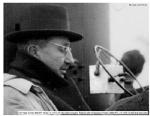
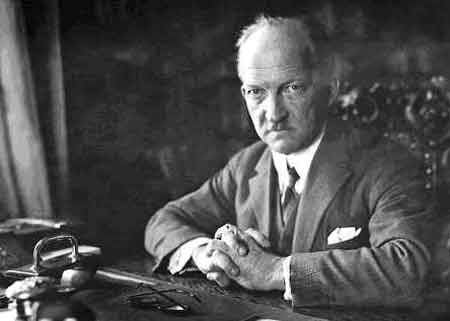
GÉZA KÁDÁR postal engineer (1907-1983)
|
|

|
Hits: 7772 Replies: 1
Radio news in the MAFIRT and in the Hungarian World News
|
|
|
Sándor Selyem-Tóth
07.Mar.09 |
1
Radio related newsreels in the MAFIRT and in the Hungarian World News from 1926 The Hungarian National Film Archives (NAVA) preserved a lot of newreels concerning radios. Hereby can be found some issues picked and chosen for your interest. The First Zala County Radio Museum Foundation ordered from this list the seemingly most interesting news spots, altogether 22 newsreels from 1926 until the 1960s. The last broadcast should have been the news regarding the printed circuit of the AR series from the ORION factory but this issue could not be found in the archives. However you can be reimbursed by a similar report on the radio Tünde (with the same technology) or by a previous spot on the radio Sonett. According to the copyrights the projection is allowed within the frames of our organizations (the Foundation and the Association of Radio Collectors), so the members shall be hopefully able to watch the 34 minutes long film in the Spring of 2009. It was not possible to check the content of some (e.g. exhibitions, fairs) matters so some pieces of news and information can occur, which are not related to radios. The report on the cathode ray tube production of Tungsram in Nagykanizsa is missing, but there is an additional report on the TV production of Vadásztölténygyár. Certainly this enumeration cannot be comprehensive but contains most of the available (public) matters of that period indeed. The further processing or the publishing by the Association of Radio Collectors on DVD could be a very important moment embalming the radio related heritage however by reading the list, it can be realised what treasures are around us which are perhaps not yet known. (The underlined news below are available to watch.) 1926: - Radio exhibition in Budapest - National Radio Exhibition 1927 - The construction of the most modern radio transmitting station in Lakihegy 1928 - Count Georg von Arco Dr. director of Telefunken Company about the construction of the new radio transmitting station in Lakihegy - The commission of the new radio transmitting station in Lakihegy - Budapest International Fair - The new Radio Studio in the Sándor Street near completion - The first radiotrain of the world started from Budapest 1929 - Animal voices in the radio. The rehearsal before the outside broadcasting of the Hungarian Broadcasting Corporation. 1930 - The handover of the public safety broadcasting system in the policemen residential district in Fehérvári Street. - The members of the International Broadcasting Union visiting the transmitting station in Lakihegy 1931 - The radio traders at the St. Steven's Day Exhibiton about the transmitting station in Lakihegy - The electronic clock towers of the Hungarian Telephone News and Broadcasting Corp. in Debrecen - The factory startup ceremony of the VATEA Radiotechonology and Electric Corp. http://filmhiradok.nava.hu/watch.php?id=48 1932 - Telephone News in hospitals in Budapest http://filmhiradok.nava.hu/watch.php?id=223 - The new Austrian invention: the speaking machine with paper tape - The ribbon cutting ceremony of the new studio in the HQ of the Hungarian Brodcasting Corp. - Radio Exhibition in Geneva 1933 - New radiostation in Pécs - The handover ceremony of the relay station in Mosonmagyaróvár http://filmhiradok.nava.hu/watch.php?id=637 - Completion of the new transmitting station in Lakihegy http://filmhiradok.nava.hu/watch.php?id=818 - The campaign speech of Hitler on radio - Radio car across the country monitoring the receiving conditions - Hungarian Radio Week and Radio Exhibition - Report on the Radio Week 1934 - The Intenational Fair is closed - Amateur hunting contest of the „Rádióélet” near Budapest 1935 - Fire in the German Broadcasting studio - The Hungarian pavilion in the exhibition in Vienna - Radio broadcasting from Budapest to England - 10th anniversary of the Hungarian Broadcasting http://filmhiradok.nava.hu/watch.php?id=1694 - Jubilee of the Hungarian radio industry http://filmhiradok.nava.hu/watch.php?id=1701 1937 - The new 280 m high antenne of the Prague radio station - Radio equipped new US army tanks 1938 - Hungarian exhibition on the Belgrad Fair 1939 - The transmitting station in Lakihegy http://filmhiradok.nava.hu/watch.php?id=3390 1940 - 500.000 broadcast subscribers 1941 - 600.000 broadcast subscribers 1942 - Brother-in-arms radio service - Grand opening of the Budapest International Fair 1943 - 50th anniversary of the Budapest Telephone News http://filmhiradok.nava.hu/watch.php?id=4936 1944 - The important product of the worldwide famous Hungarian electronic industry: the radio tube 1946 - The new 50 kW transmitting statation in Lakihegy 1948 - The ribbon cutting ceremony of the big radio transmitter 1954 - Petőfi Radio (New broadcasting studio in Balatonszabadi) 1955 - 30th annyiversary of the Hungarian Broadcasting Corp. 1956 - Radio exhibition in Yugoslavia 1957 - Pocket radio Sonett (hungarian models in the Budapest Industrial Fair) 1959 - TV production in the Vadásztölténygyár - New tranzistor radio (Tünde) - Coj-hen-gen in the Telefongyár 1960 - Radio with printed circuit (AR serial at the Orion) 1966 - Radio instrument (Patent of Zoltan Papp technician) 1970 - 25th anniversary of the radio transmitting station 1976 - 50th anniversary of the Hungarian Broadcasting Corp. Zalaegerszeg, February 2009 Sándor Selyem Tóth First Zala County Radio Museum Foundation Further information on Count Georg von Arco Dr.: Hungarian: English version: http://www.zalaszam.hu/radio/unicum/1e.htm
|
|
Sándor Selyem-Tóth
09.Nov.09 |
2
1a./
Új rádióállomás Pécsett -New Radio Station Pécs http://filmhiradok.nava.hu/watch.php?id=601
Embed: <object width='430' height='400'><param name='movie' value='http://widget.nava.hu/neumann_l.swf?sort=0&startpage=0&results=0&filmID=601&wmode=2&uID=172779235'/><param name='allowFullScreen' value='true'/><param name='allowscriptaccess' value='always'/><embed src='http://widget.nava.hu/neumann_l.swf?sort=0&startpage=0&results=0&filmID=601&wmode=2&uID=1349446737' type='application/x-shockwave-flash' allowscriptaccess='always' allowfullscreen='true' width='430' height='400'/>
1b./
The factory startup ceremony of the VATEA Radiotechonology and Electric Corp. http://filmhiradok.nava.hu/watch.php?id=48
Embed: <object width='430' height='400'><param name='movie' value='http://widget.nava.hu/neumann_l.swf?sort=0&startpage=0&results=0&filmID=48&wmode=2&uID=1280561799'/><param name='allowFullScreen' value='true'/><param name='allowscriptaccess' value='always'/><embed src='http://widget.nava.hu/neumann_l.swf?sort=0&startpage=0&results=0&filmID=48&wmode=2&uID=1738123980' type='application/x-shockwave-flash' allowscriptaccess='always' allowfullscreen='true' width='430' height='400'/>
2./
A magyaróvári rádió-relé állomás felavatása - The handover ceremony of the relay station in Mosonmagyaróvár
Embed: <object width='430' height='400'><param name='movie' value='http://widget.nava.hu/neumann_l.swf?sort=0&startpage=0&results=0&filmID=637&wmode=2&uID=412784204'/><param name='allowFullScreen' value='true'/><param name='allowscriptaccess' value='always'/><embed src='http://widget.nava.hu/neumann_l.swf?sort=0&startpage=0&results=0&filmID=637&wmode=2&uID=1810114521' type='application/x-shockwave-flash' allowscriptaccess='always' allowfullscreen='true' width='430' height='400'/>
3./
Elkészült a lakihegyi új nagyadó-állomás - Completion of the new transmitting station in Lakihegy
<object width='430' height='400'><param name='movie' value='http://widget.nava.hu/neumann_l.swf?sort=0&startpage=0&results=0&filmID=818&wmode=2&uID=1554597592'/><param name='allowFullScreen' value='true'/><param name='allowscriptaccess' value='always'/><embed src='http://widget.nava.hu/neumann_l.swf?sort=0&startpage=0&results=0&filmID=818&wmode=2&uID=1582438096' type='application/x-shockwave-flash' allowscriptaccess='always' allowfullscreen='true' width='430' height='400'/>
4./
Gömbös Gyula avatta fel az új lakihegyi rádió-nagyadó-állomást http://filmhiradok.nava.hu/watch.php?id=843
Embed: <object width='430' height='400'><param name='movie' value='http://widget.nava.hu/neumann_l.swf?sort=0&startpage=0&results=0&filmID=843&wmode=2&uID=1878499666'/><param name='allowFullScreen' value='true'/><param name='allowscriptaccess' value='always'/><embed src='http://widget.nava.hu/neumann_l.swf?sort=0&startpage=0&results=0&filmID=843&wmode=2&uID=2088019833' type='application/x-shockwave-flash' allowscriptaccess='always' allowfullscreen='true' width='430' height='400'/>
5./
Tízéves a magyar rádió - 10th anniversary of the Hungarian Broadcasting
Embed: <object width='430' height='400'><param name='movie' value='http://widget.nava.hu/neumann_l.swf?sort=0&startpage=0&results=0&filmID=1694&wmode=2&uID=533619188'/><param name='allowFullScreen' value='true'/><param name='allowscriptaccess' value='always'/><embed src='http://widget.nava.hu/neumann_l.swf?sort=0&startpage=0&results=0&filmID=1694&wmode=2&uID=774472788' type='application/x-shockwave-flash' allowscriptaccess='always' allowfullscreen='true' width='430' height='400'/>
6./
Jubiláló rádióiparunk - Jubilee of the Hungarian radio industry
Embed: <object width='430' height='400'><param name='movie' value='http://widget.nava.hu/neumann_l.swf?sort=0&startpage=0&results=0&filmID=1701&wmode=2&uID=1770056847'/><param name='allowFullScreen' value='true'/><param name='allowscriptaccess' value='always'/><embed src='http://widget.nava.hu/neumann_l.swf?sort=0&startpage=0&results=0&filmID=1701&wmode=2&uID=892005324' type='application/x-shockwave-flash' allowscriptaccess='always' allowfullscreen='true' width='430' height='400'/>
7./
Lakihegyi rádióállomás. http://filmhiradok.nava.hu/watch.php?id=3390
Embed: <object width='430' height='400'><param name='movie' value='http://widget.nava.hu/neumann_l.swf?sort=0&startpage=0&results=0&filmID=3390&wmode=2&uID=2142360263'/><param name='allowFullScreen' value='true'/><param name='allowscriptaccess' value='always'/><embed src='http://widget.nava.hu/neumann_l.swf?sort=0&startpage=0&results=0&filmID=3390&wmode=2&uID=925380907' type='application/x-shockwave-flash' allowscriptaccess='always' allowfullscreen='true' width='430' height='400'/>
8./
50 éves a budapesti Telefonhírmondó - 50th anniversary of the Budapest Telephone News
Embed: <object width='430' height='400'><param name='movie' value='http://widget.nava.hu/neumann_l.swf?sort=0&startpage=0&results=0&filmID=4936&wmode=2&uID=1512397526'/><param name='allowFullScreen' value='true'/><param name='allowscriptaccess' value='always'/><embed src='http://widget.nava.hu/neumann_l.swf?sort=0&startpage=0&results=0&filmID=4936&wmode=2&uID=1575009531' type='application/x-shockwave-flash' allowscriptaccess='always' allowfullscreen='true' width='430' height='400'/>
Regards:
STS
|
End of forum contributions about this country
| Data Compliance | More Information |