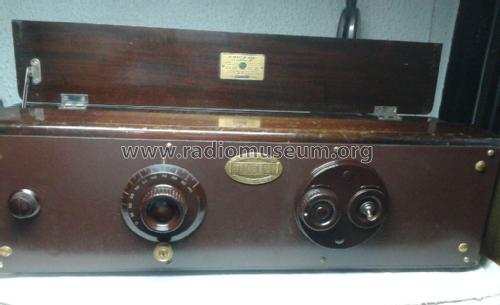
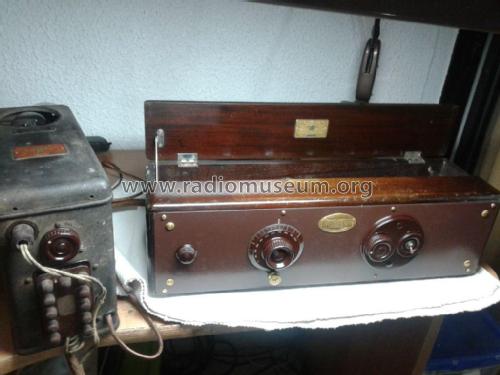
Model: 36 early


Antique radios, Old Time Radios

36 early
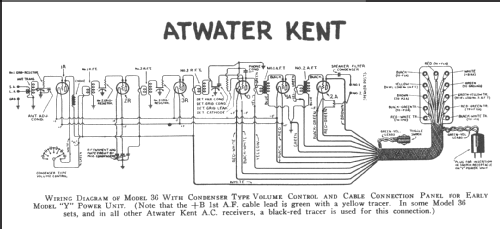
condenser type volume control
Country:
United States of America (USA)
Manufacturer/Brand:
Atwater Kent Mfg. Co.; Philadelphia, USA
Year: 1927
Type:
Radio or TunerBroadcast receiver (Radio).
Im Gegensatz zu Radioempfängern für kommerzielle und/oder militärische Zwecke und den frühen Empfängern für Morsezwecke nennen wir hier Radio bzw. Rundfunkempfänger. Aber: Gemäss internationaler Sprachregelung führt der Radiokatalog Band 1 alle Empfänger mit aktiven Bauteilen als RADIO. Wir unterscheiden hier ebenfalls nicht, ob mit Röhren bestückt, hybrid, mit Transistoren oder/und ICs.
Mod.-ID = 33251
previous
|
Result List
|
next
|
New search for Radios etc.
Schematics etc.: 1 (for
members)
Principle
TRF without reaction (non reg.dir.receiver)TRF without manual regenerative (feed-back) control.
Geradeaus ohne bedienbare Rückkopplung - zumindest ohne Übersteuerungsmöglichkeit. Demodulation durch Audion. In der Schweiz waren z.B. Rückkoppler mit Übersteuerungsmöglichkeit generell verboten, damit Nachbarn keine Störungen befürchten müssen.
Tuned circuits
4 AM circuit(s);
Wave bands
Broadcast only (MW).Mittelwellenempfänger
Power type and voltage
Alternating Current supply (AC) / 115 VoltAC set plus voltage range.
/ = 2 different voltages
- = voltage from-to
* = «Special»
Apparareil à courant alternatif. Tensions mentionnées.
/ = 2 Spannungswahlen
- = von-bis
* = Fabrikwahl/«Spezial»
Normalerweise sind diese Geräte mit einem Trafo mit Primär- und Sekundärwicklungen versehen. Dadurch führt das Chassis kein gefährliches Potential.
Loudspeaker/pwr.out
- This set has no built-in loudspeaker (separate or not necessary).This set has no built-in loudspeaker. It requires a separate loudspeaker or headset - or the set has no speaker output (not a radio).
Cet appareil n`a pas d`haut-parleur.
Das Gerät verfügt nicht über einen eingebauten Lautsprecher - entweder weil er nicht nötig ist (Gerät hat keine Tonwiedergabe) oder weil er separat zu stellen ist - bzw. das Gerät ist für Kopfhörerbetrieb.
www.radiomuseum.org
Model: 36 early condenser type volume control
Material
Wooden caseWooden case. Most radios have a wooden cabinet until the WW2. Caisse en bois.
Die meisten Heim-Rundfunkempfänger führen von Beginn an bis etwa Ende 60er Jahre Holz als Gehäuse. Auch frühe Reiseempfänger zeigen Holz (speziell in den 20er Jahren) oder Holz mit Stoffüberzug etc.
Shape
Tablemodel, Box - most often with Lid (NOT slant panel).
Dimensions (WHD)
21 x 6.3 x 6.3 inch / 533 x 160 x 160 mm
Valves / Tubes
7:
26
(more
for members)
Notes
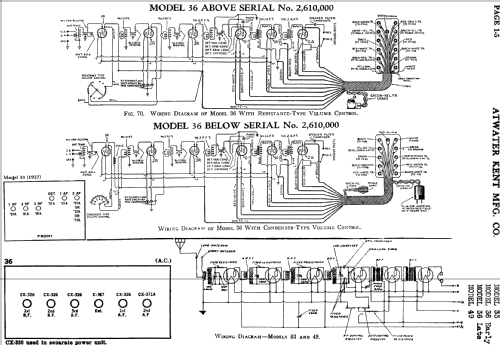
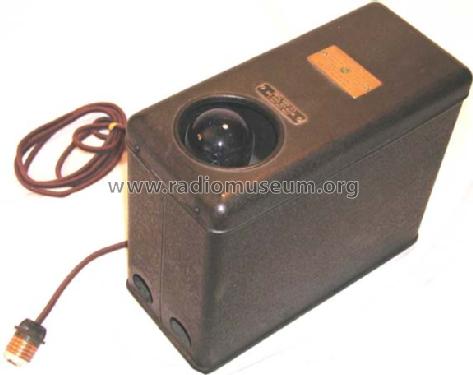
early = below serial No.2,610,000; uses capacitive vol.control and separate power supply "Y early";
External source of data
Ernst Erb
Source of data
A.Atwater Kent, The Man, 2002A.Atwater Kent,The Man, the Manufacturer and His Radios, 2002, by Ralph Williams and John P.Wolkonowicz, edited by Donald O.Patterson.
Circuit diagram reference
Rider's Perpetual, Volume 1The Riders Perpetual contains 23 volumes of schematics. They can be ordered at: Alton H. Bowman, 4172 East Ave, RD 2, Canandaigua, NY 14424-9564, USA.
For your information:
Other big collections of schematics for the USA are the books «Most-Often-Needed Radio Diagrams», compiled by M.N.BEITMAN (beginning: 1926-1938 = Vol. 1).
and folders from:
Howard W. Sams Company, 2647 Waterfront Parkway East Drive, Indianapolis, IN 46214-2041, Tel.: 1-800-GET-SAMS or 1-800-428-5331 or 726
Mentioned in
Radio Manufacturers of the 20s, Vol 1, DouglasRadio Manufacturers of the 1920s Volume 1 of 3 (Third Printing of 1995) by Alan Douglas, The Vestal Press Ltd., USA.
Literature/Schematics
Collector's Guide to AR6.Ed. Slusser tubeCollectors Guide to Antique Radios, 6th Edition, 2005 by John Slusser. See also other editions (incl. Bunis).
By courtesy of William Kendrick, USA
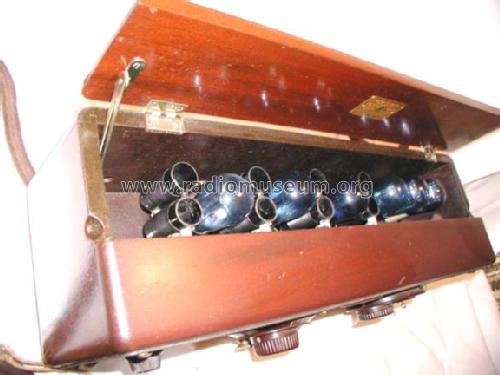
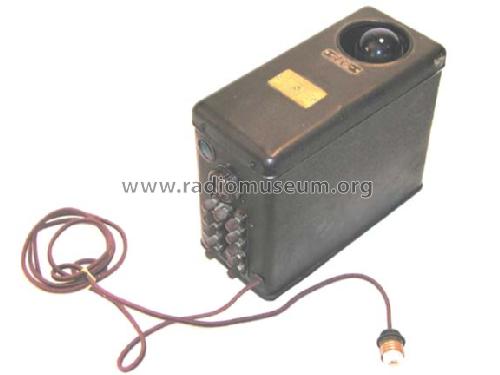
More pictures
Further information on
36 early condenser type volume control (Atwater Kent Mfg. Co.; Philadelphia, USA)
Bild und Daten wie "36"; HF-Lautstärkeregelung zwischen 1.u.2.HF-Stufe über umschaltbare Kondensatoren