- Country
- United States of America (USA)
- Manufacturer / Brand
- Lafayette Radio & TV Corp; New York (NY)
- Year
- 1938
- Category
- Broadcast Receiver - or past WW2 Tuner
- Radiomuseum.org ID
- 92828
-
- alternative name: Wholesale Radio
- Number of Tubes
- 9
- Main principle
- Superheterodyne (common)
- Wave bands
- Broadcast, Short Wave(s) and Police.
- Power type and voltage
- AC/DC-set / 110 Volt
- Loudspeaker
- Electro Magnetic Dynamic LS (moving-coil with field excitation coil) / Ø 8 inch = 20.3 cm
- Material
- Wooden case
- from Radiomuseum.org
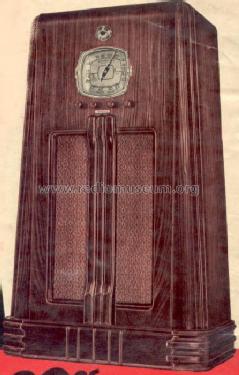
- Model: FS47 - Lafayette Radio & TV Corp; New
- Shape
- Console with any shape - in general
- Notes
- Ballast 2x33A . This seems one of the objects in the "Tube Count Scandal" about 1935 to 1938, when some manufacturers started adding nonfunctional or unnecessary tubes to increase the number. Such a set was then offered for a fraction of what was one having the legitimate tube count and functionality. In our case here the radio features three ballasts and two rectifiers. Each rectifier tube can take 75 mA continuously DC, even as a doubler, while the Power tube draws only a total of ca 50 mA.
- Mentioned in
- Collector's Guide to Antique Radios (6th edition)
- Literature/Schematics (1)
- 1938 Lafayette Catalog Nº 69
- Author
- Model page created by Vitor Oliveira. See "Data change" for further contributors.
- Other Models
-
Here you find 1369 models, 1187 with images and 421 with schematics for wireless sets etc. In French: TSF for Télégraphie sans fil.
All listed radios etc. from Lafayette Radio & TV Corp; New York (NY)
Forum contributions about this model: Lafayette Radio & TV: FS47
Threads: 1 | Posts: 4
Obviously this model has unnecessarily three ballasts and two rectifiers. The filaments for the lineup including one rectifier are adding up to 80 volts, so one ballast would have done.
But another three cheap tubes were added to increase the necessary number of eight to the better selling eleven tubes!
This kind of business started from 1935/36 and became public in 1937, when this tube count scandal was revealed. In 1939 the trouble was over.
Ref.: Mark V.Stein, Pre-War Consoles.
But another three cheap tubes were added to increase the necessary number of eight to the better selling eleven tubes!
This kind of business started from 1935/36 and became public in 1937, when this tube count scandal was revealed. In 1939 the trouble was over.
Ref.: Mark V.Stein, Pre-War Consoles.
Konrad Birkner † 12.08.2014, 15.Mar.06