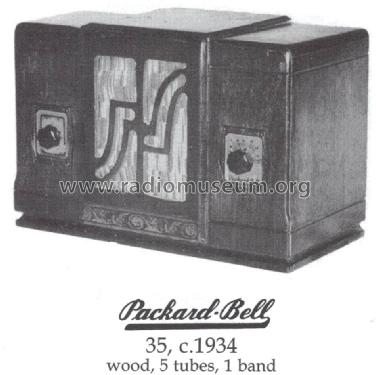
Model: 35


Antique radios, Old Time Radios

35
intermediate
Country:
United States of America (USA)
Manufacturer/Brand:
Packard Bell Co.; Los Angeles (CA)
Year: 1935 ?
Type:
Radio or TunerBroadcast receiver (Radio).
Im Gegensatz zu Radioempfängern für kommerzielle und/oder militärische Zwecke und den frühen Empfängern für Morsezwecke nennen wir hier Radio bzw. Rundfunkempfänger. Aber: Gemäss internationaler Sprachregelung führt der Radiokatalog Band 1 alle Empfänger mit aktiven Bauteilen als RADIO. Wir unterscheiden hier ebenfalls nicht, ob mit Röhren bestückt, hybrid, mit Transistoren oder/und ICs.
Mod.-ID = 117456
previous
|
Result List
|
next
|
New search for Radios etc.
Schematics etc.: 2 (for
members)
Principle
Super-Heterodyne (Super in general); IF-Freq. 460 kHzSuperhet - normally without a preamplification stage (as far as known). Please use «To add informations to model» if you know more! Thanks.
Récepteur TSF superhétérodyne. Normalement sans préamplification de HF.
Superhet ohne Vorstufe.
Nicht immer war bei der Erfassung klar, ob der Empfänger eine Vorstufe aufweist oder nicht. Im Zweifelsfall kam das Gerät in diese Kategorie.
Tuned circuits
4 AM circuit(s);
Wave bands
Broadcast only (MW).Mittelwellenempfänger
Power type and voltage
Alternating Current supply (AC)AC set plus voltage range.
/ = 2 different voltages
- = voltage from-to
* = «Special»
Apparareil à courant alternatif. Tensions mentionnées.
/ = 2 Spannungswahlen
- = von-bis
* = Fabrikwahl/«Spezial»
Normalerweise sind diese Geräte mit einem Trafo mit Primär- und Sekundärwicklungen versehen. Dadurch führt das Chassis kein gefährliches Potential.
Loudspeaker/pwr.out
Electro Magnetic Dynamic LS (moving-coil with field excitation coil)Electro magnetic dynamic loudspeaker (moving-coil principle by Rice-Kellog) with field excitation coil - mostly used as choke.
Haut parleur dynamique avec bobine d`excitation - plus souvent aussi utilisé pour le self.
Elektrodynamischer Lautsprecher mit Erregerspule für das Magnetfeld (Fremderregung), meist gleichzeitig als Siebglied dienend.
www.radiomuseum.org
Model: 35 intermediate
Material
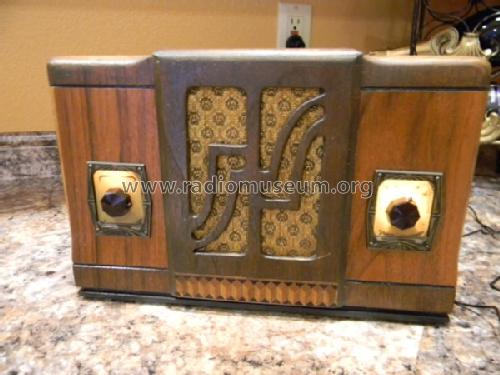
Wooden caseWooden case. Most radios have a wooden cabinet until the WW2. Caisse en bois.
Die meisten Heim-Rundfunkempfänger führen von Beginn an bis etwa Ende 60er Jahre Holz als Gehäuse. Auch frühe Reiseempfänger zeigen Holz (speziell in den 20er Jahren) oder Holz mit Stoffüberzug etc.
Shape
Tablemodel, Mantle/Midget/Compact but not a Portable (Mains only).
Valves / Tubes
5:
6C6
(more
for members)
Notes
There are 3 variants having different tube lineup: 35 early, 35 intermediate, and 35 late.
Circuit diagram reference
Rider's Perpetual, Volume 6Ave, RD 2, Canandaigua, NY 14424-9564, USA.
For your information:
Other big collections of schematics for the USA are the books «Most-Often-Needed Radio Diagrams», compiled by M.N.BEITMAN (beginning: 1926-1938 = Vol. 1).
and folders from:
Howard W. Sams Company, 2647 Waterfront Parkway East Drive, Indianapolis, IN 46214-2041, Tel.: 1-800-GET-SAMS or 1-800-428-5331 or 7267.
Literature/Schematics
Rider's Perpetual, Volume 7The Riders Perpetual contains 23 volumes of schematics. They can be ordered at: Alton H. Bowman, 4172 East Ave, RD 2, Canandaigua, NY 14424-9564, USA.
For your information:
Other big collections of schematics for the USA are the books «Most-Often-Needed Radio Diagrams», compiled by M.N.BEITMAN (beginning: 1926-1938 = Vol. 1).
This model was suggested by Konrad Birkner.
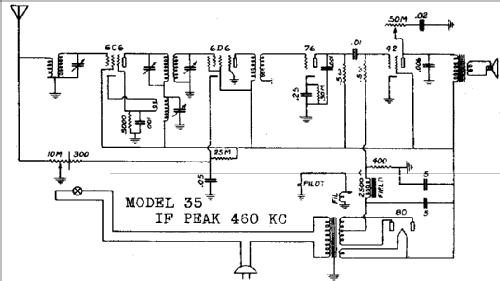
Packard Bell Model 35
No further information
on
35 intermediate (Packard Bell Co.; Los Angeles (CA))