- Country
- Germany
- Manufacturer / Brand
- Telefunken Deutschland (TFK), (Gesellschaft für drahtlose Telegraphie Telefunken mbH
- Year
- 1942–1945
- Category
- Military Receiver
- Radiomuseum.org ID
- 70834





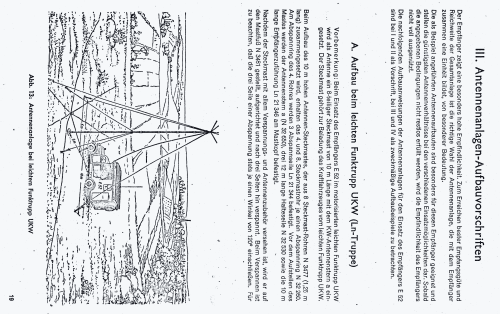


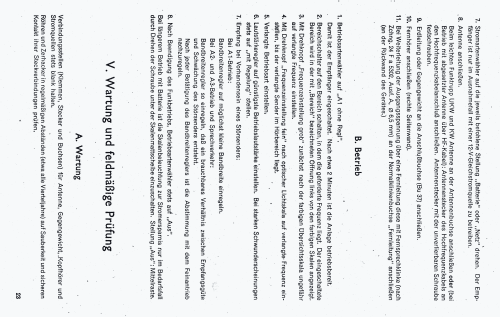
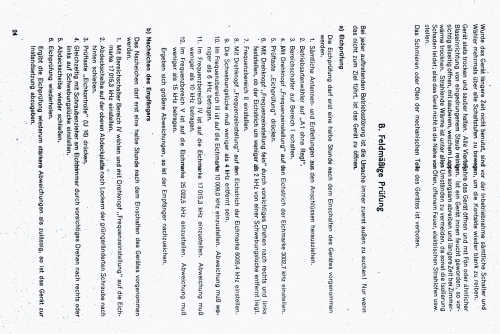

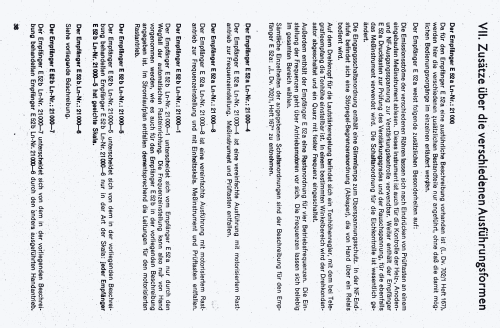

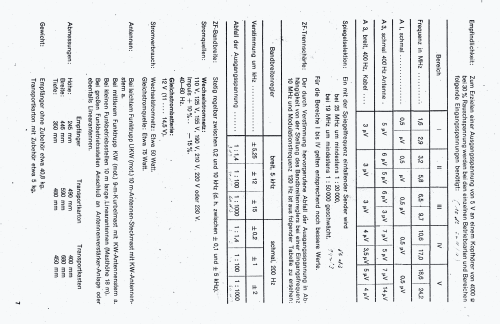
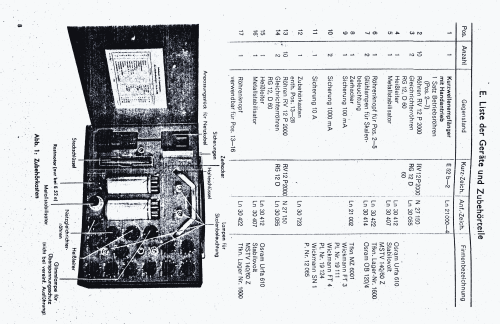
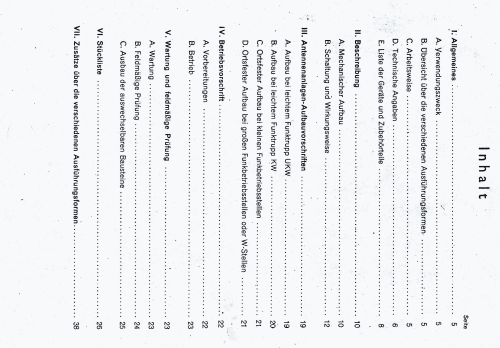

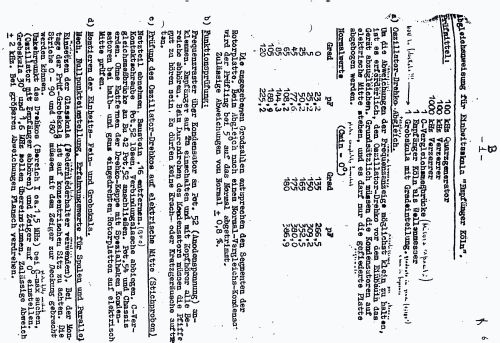


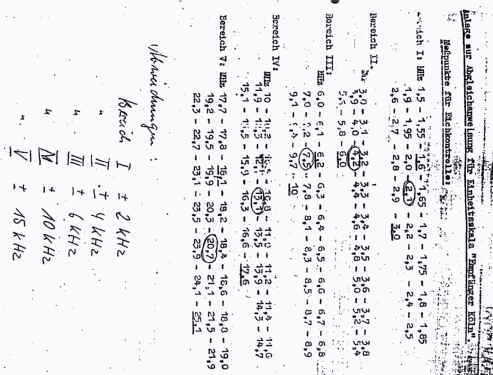







Click on the schematic thumbnail to request the schematic as a free document.
- Number of Tubes
- 12
- Main principle
- Superhet with RF-stage; ZF/IF 1000 kHz; 2 AF stage(s)
- Wave bands
- Broadcast plus more than 2 Short Wave bands.
- Power type and voltage
- Line / Batteries (any type) / 12/110-220 Volt
- Loudspeaker
- - For headphones or amp.
- Material
- Metal case
- from Radiomuseum.org
- Model: Köln E52 / T8K44 - Telefunken Deutschland TFK,
- Shape
- Boatanchor (heavy military or commercial set >20 kg).
- Dimensions (WHD)
- 445 x 245 x 350 mm / 17.5 x 9.6 x 13.8 inch
- Notes
- 1500 - 25000 kHz in 5 Bereichen, AM/CW mit BFO, regelbares ZF-Quarzfilter, Projektionsskala. Variante "a" mit Motorabstimmung, "b" ohne. Stückzahl ca. 6000, für deutsche Wehrmacht. Wurde auch von anderen Firmen gebaut. Später Verwendung in staatlichen Stellen und Amateurfunk. Zubehör: Seitenband-Auswahlgerät (EB1/3a 9Funk üstr 144K1), Peilzusatz (FuPeil A70k).
- Net weight (2.2 lb = 1 kg)
- 41 kg / 90 lb 4.9 oz (90.308 lb)
- Mentioned in
- Die Deutschen Funknachrichtenanlagen, Bd. 2 (Kalibriervorgang: GFGF Funkgeschichte Nr. 92 (1993) S 219ff.)
- Literature/Schematics (1)
- Museums Bote, Österr. (Heft 126/2004, S.13 ff, Gerätebeschreibung u. Varianten)
- Author
- Model page created by a member from D. See "Data change" for further contributors.
- Other Models
-
Here you find 3546 models, 3126 with images and 2095 with schematics for wireless sets etc. In French: TSF for Télégraphie sans fil.
All listed radios etc. from Telefunken Deutschland (TFK), (Gesellschaft für drahtlose Telegraphie Telefunken mbH
Forum contributions about this model: Telefunken: Köln E52 / T8K44
Threads: 2 | Posts: 5
TELEFUNKEN E52 KÖLN OVERVIEW
History:
Empfänger 52 was specified by the Reichsluftfahrtministerium (RLM) in 1939 as one in a series of five similar receivers covering the entire frequency spectrum from LF to UHF, intended for use in the Luftwaffe ground stations, but also for other services and authorities. A request for quotation went out to a few German electronics manufacturers and Telefunken developed and built a prototype of the short wave receiver Köln in the beginning of 1941. Telefunken was chosen to manufacture the series of receivers according to their specification ”Luftboden-Empf.-Programm 2 – 7500 m für die Bodenausrüstung der deutschen Luftwaffe”, Telefunken Berlin-Zehlendorf 5.5.1941.
Out of four specified receivers E51 Leipzig (LF), E52 Köln (HF), E53 Ulm (VHF) and E54 Kulm (UHF) only Köln was built in large series. In total around 2500 receivers were built from July 1942 to March 1945. The E52 was made in 10 models, of which the E52a-1 (simplified with automatic tuning) and E52b-2 (simplified with manual tuning and unified scale) were the most common. Of all the E52s built there are probably 300 - 500 left, of these perhaps 50 in there original state.
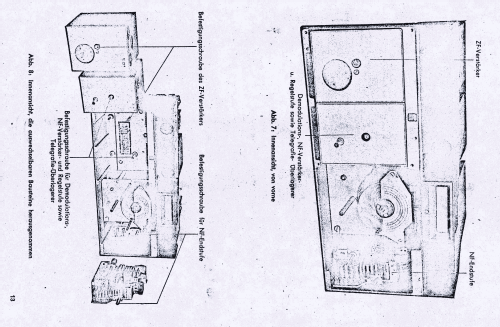
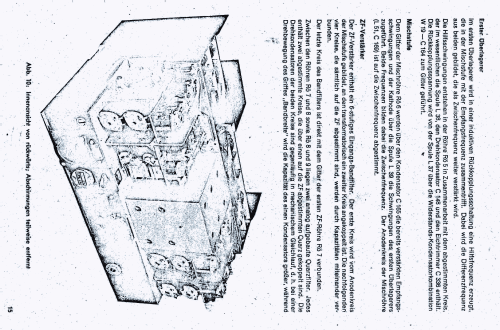
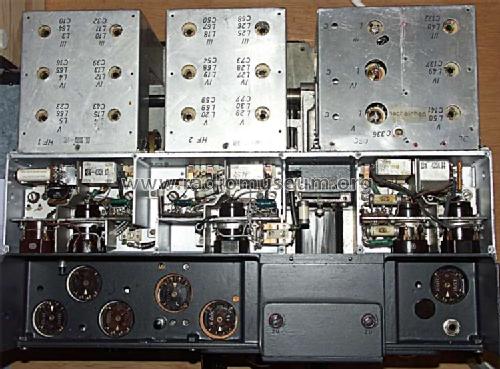
The receiver is modularised, the modules are mounted in a moulded aluminium chassis and all connections between the modules are through connectors in a backplane! Both the construction and the performance were far ahead of its time. Only one type of valve, the RV12P2000, was used in the receiver except for the power rectifiers. The intention was that all modules and valves should be interchangable in the field without the need for realignment. The first test series of around 20 receivers was made in Sachsenwerk in Radeberg from July 1942 of the simplified type E52a-1 and possibly also the type E52b-1. The manufacture was not up to speed until the beginning of 1943. The assembly and alignment was made in Sachsenwerk Niedersedlitz while the modules were made in several different electronics industries.
Receiver data:
The receiver is an advanced single superheterodyne with two RF stages, mixer/local oscillator, three IF stages, detector/BFO/AF amplifier and an output stage for headphones. In total there are 6 tuned circuits in the RF/mixer/oscillator part and the receiver has very high sensitivity and selectivity. The IF stages have a 6-circuit filter plus 4 tunable circuits in a variable crystal filter, the bandwith is variable from +/- 5 kHz down to +/- 200 Hz @-3dB with very steep slopes, damping 100 times at +/- 10 kHz in wide. The tuning has a coarse scale and a fine scale projected from a micro photo disc with very high resolution and accuracy. The oscillator has very accurate temperature compensation and thus high stability. Frequency coverage is 1.5 to 25 Mhz in five bands, the sensitivity for AM 3 - 5 uV, CW wide 1.0 uV and CW narrow 0.3 uV for 5 V output. Mirror frequency damping is at least 50000 and the IF damping is better than 100000 at 1.5 MHz. The stability is better than 30x 10E-6/degree C, that is 30 Hz/MHz/degree C for a freerunning oscillator! Even today this is competitive against many modern receivers comparing sensitivity, selectivity and stability.
Variants:
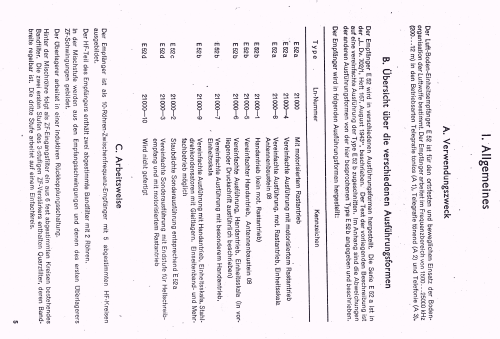
Type Ln-number Remarks
E52a 21000 Motorised tuning
E52b 21000-1 Manual tuning
E52c 21000-2 Dust proof special type, like E52a
E52d 21000-3 Simplified, motorised, special
tuning, recorder output
E52a-1 21000-4 Simplified, motorised tuning
E52b-1 21000-5 Simplified, manual tuning
E52b-2 21000-6 Simplified, manual tuning, unified scale
E52b-3 21000-7 Simplified, special manual tuning
E52a-2 21000-8 Simplified, motorised tuning, unified scale
E52b-4 21000-9 Simplified, manual tuning, unified scale, SSB, steel condensors
It should be pointed out that there is no absolute right or wrong when it comes to the original state of the different models. The receiver was continually changed and the borders between the models are floating. The modules were modified and exchanged between the receivers for repair, there can be a-modules in b-, c- and d-models and vice versa. You can find components in the schematic diagram for E52-b2 for which there is a remark in the parts list ”erscheint nicht”, does not exist!
For more details and references, please visit my web pages at http://goto.glocalnet.net/bosradio
Bo Samuelsson, 25.Dec.06
I bought an E52a-1 Köln from a colleague around 1960. As I was young and foolish I repainted it and "modernised" some of the modules with miniature valves like 6AK5 and 6X8. After that the receiver did not work well, probably due to bad alignment of the tuning condenser.
Now I am a lot older and hopefully wiser and I have restored the E52 to a state as close to the original as possible. The receiver was far ahead of its time with very high sensitivity (2 RF and 3 IF stages), selectivity (2 crystal controlled variable bandwith stages +-200 to +- 5000 Hz) and stability (carefully temperature compensated circuits). The design was using interchangeable modules, a wiring backplane and the same valve throughout the receiver stages, RV12P2000. There was also a very accurate projected dial for the tuning.
I have attached pictures of my receiver before and after restoration. It is now working very well on three of the bands. In step two I will restore the remaining 2 bands. More details and pictures in my web pages at http://goto.glocalnet.net/bosradio .
Attachments
- My E52 Köln before restoration (53 KB)
- My E52 Köln after restoration (115 KB)
- Top view of receiver (78 KB)
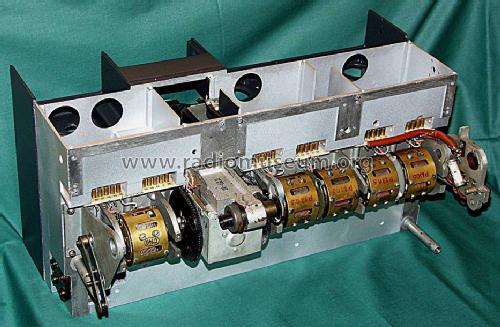
- Tuning condenser during assembly (112 KB)
- Back view with osc-mixer coils (78 KB)
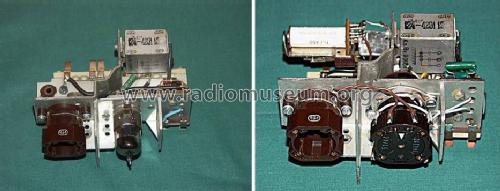
- RF stage 1 before and after restoring (56 KB)
- IF module, original (108 KB)
Bo Samuelsson, 23.Dec.06