|
|
||||
|
alternative name
|
Chicago Radio Lab | ||||
|---|---|---|---|---|---|
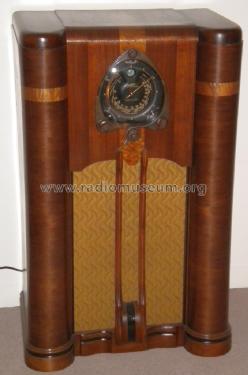
| Year: 1937 | Type: Radio - or past WW2 tuner | ||||
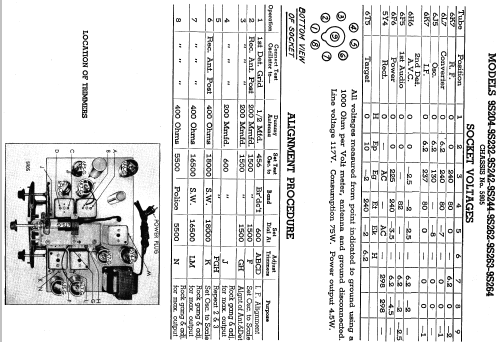
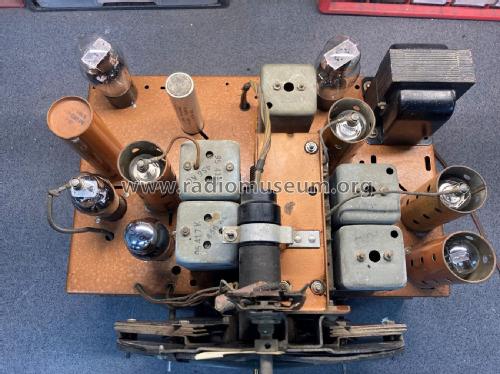
| Valves / Tubes | 9: 6K7G 6L7G 6K7G 6K7G 6T5 6H6G 6F5G 6F6G 5Y4G |
| Principle | Superhet with RF-stage; ZF/IF 456 kHz |
|---|---|
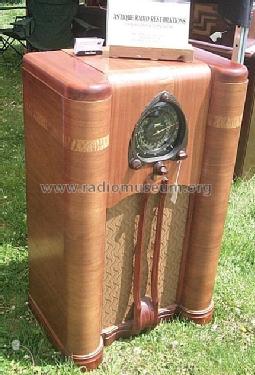
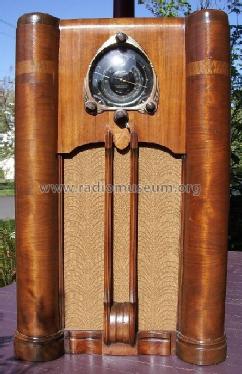
| Wave bands | Broadcast, Short Wave(s) and Police. |
| Details | |
| Power type and voltage | Alternating Current supply (AC) / 115 Volt |
| Loudspeaker | Electro Magnetic Dynamic LS (moving-coil with field excitation coil) / Ø 12 inch = 30.5 cm |
| Power out | 4.5 W (unknown quality) |
| from Radiomuseum.org | Model: 9S262 9-S-262 Ch=5905 - Zenith Radio Corp.; Chicago, |
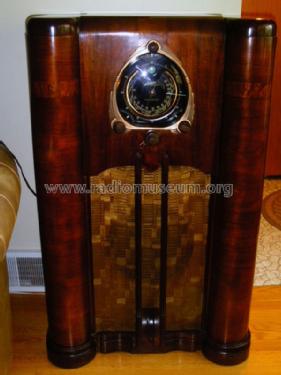
| Material | Wooden case |
| Shape | Console with any shape - in general |
| Dimensions (WHD) | 26.9 x 42 x 16.8 inch / 683 x 1067 x 427 mm |
| Price in first year of sale | 100.00 $ |
| Collectors' prices | 3 Collector prices (for members Radiomuseum.org) |
| External source of data | Ernst Erb |
| Source of data | The Radio CollectorGrinder, 1995 |
| Circuit diagram reference | Rider's Perpetual, Volume 8 = 1937 and before |
| Mentioned in | Collector's Guide to AR4.Ed.,Bunis, tube |
| Literature/Schematics (1) | Zenith The Glory Years, Cones,03 |
| Literature/Schematics (2) | Pre-War Consoles; Stein, 2000 |
All listed radios etc. from Zenith Radio Corp.; Chicago, Illinois
Here you find 3382 models, 2468 with images and 2648 with schematics.
Collection of Aleksander Kowal (USA)
Collection of Michael Slusser (USA)
|
Hits: 3217 Replies: 0
zenith: (9-S-262 Ch=5905); 9S262 would like assistance
|
|
|
Joe Rose
25.Nov.08 |
1
Is some one willing to assist me in troubleshooting my Zeinth 9s262, Shutter Dial. My background kind of goes like: About 1963, I took tube radio repair in vocational high school just as transistors came on the scene and the demand for warm bodies for Viet-Nam draft soared. Since I had a rudimentary understanding of radio electronics, the decision was made to use those skillls in selecting my military career path which was of course engine mechanics. That never detered me from my path of radio collecting. Over the last 40 years I have maintained a collection which now numbers 95-100 radios and spring wound phonographs. I decided I would collect while I had the opportunity and as I neared retirement I would begin what I like to call "polishing" my collection. Which, after all of that, brings me to my point. Man, have I ever forgotten what I thought I knew about radio servicing. Most of the time, I'm lucky and find a bad tube or a melted capicator but not this time. I bought two Zenith consoles at a real good price, both in 7 or 8 out of 10 in quality. The 10s470 is great, looks to have been serviced by a Zenith dealer....all Zenith components plays and sounds new. The other is a 9s262 Shutter Dial. Initial tube checks showed the 6F6 Audio tube with extremely low emmision. I replace the 6F6 and now it overheats and will leave a blister if you touch it. Audio is very low no matter where the volume is....selectivity is marginal. A signal at the volume control indicates that the amp is working. If speaker is disconnected the tube won't overheat but will overheat on a known good speaker with the same load. The absolute worst is that someone has been in the set changing capacitors and I'm not sure where to start. Any guidence will be sincerely appreciated |
|
John Kershaw
26.Nov.08 |
2
Hi Joe, Do you have the schematic? If not, download it from here: http://www.nostalgiaair.org/Resources/500/M0025500.htm The most likely cause of your problem is the audio coupling capacitor C16, .02mfd leaking DC voltage. Gary (Montreal) |
|
Joe Rose
26.Nov.08 |
3
Good evening Gary, I appreciate your assistance as well as your expertise to chase down this problem. I do have a schematic from the website you recommended. Capacitor C16 had been changed out prior to my ownership of the radio in question. I did disconnect one end and checked it for shorts with none indicated. A check on a capacitance meter showed it well within 20% of .02 mfd spec. Did I mention the 6F6 was dead when I started this project? I don't know whether it matters or not. Any additional suggestions will be sincerely appreciated. Best regards, Joe (Central Michigan, USA) |
|
Emilio Ciardiello
27.Nov.08 |
4
Dear Joe, Best regards, Emilio |
|
Giovanni Bruzzi
27.Nov.08 |
5
I also would check out the output transformer to look for a short circuit. Giovanni |
|
Nikolaus Löwe
27.Nov.08 |
6
Dear Joe, in your set, grid bias for the 6F6 output tube ist generated by a dropping resistor in the return wire to the center tap of the power transformer. From the looks of the schematic, this appears to be a wire-wound resistor containing several sections. Anyhow, with a cold set there should be 250+50+85 (= 385) Ohms between the cathode (pin 8) of the 6F6 and the power tranformer center tap. Check this; an error up to 20% won´t harm. In operation, the center tap must be negative towards the chassis by the amount of the bias voltage, which ought to be about 16V, as Emilio pointed out. The bias generated across this dropping resistor is then smoothed by RC-combination R3/C2. A short in C2 or a defective R3 would disturb the bias, possibly tying it to zero, and could be responsible for overheating and destruction of the 6F6, even if the grid coupling condenser is perfectly o.k. Hope this helps, Nikolaus |
|
Joe Rose
27.Nov.08 |
7
Gentlemen, Emilio, Giovanni and Nikolaus, My sincere thanks for your expertise and insight. At this time, all I have done is measure the voltage from pin 5 control grid to pin 8 cathode. Measurment was taken with both a Fluke 77 DMM and a Simpson 260 VOM with both indicating a voltage of 0.30 volts with the control grid being positive and the cathode being negative. I will follow Giovanni's advice and make some resistance measurments as outlined in his post. It is a holiday here and I have done the eat too much and take a trip around the world at the local cinema with the new James Bond flick which makes a tiring day. The shutter dial will have to wait till I catch up. I really appreciate your help with my old Zenith, it is fun getting my fingers back in the works. I will post as soon as I digest this information and take measurements. Kind regards, Joe |
|
Emilio Ciardiello
28.Nov.08 |
8
Dear Joe, |
|
Emilio Ciardiello
28.Nov.08 |
9
Dear Joe, I forgot to add a resistance check between grid and cathode of the 6F6. I do not know if you already checked the resistors. If both R3 and R13 are good, you should find value not greater than 650 or 700 Kohms. An open resistor could also be responsible for the wrong bias. Regards again, Emilio |
|
Joe Rose
04.Jan.09 |
10
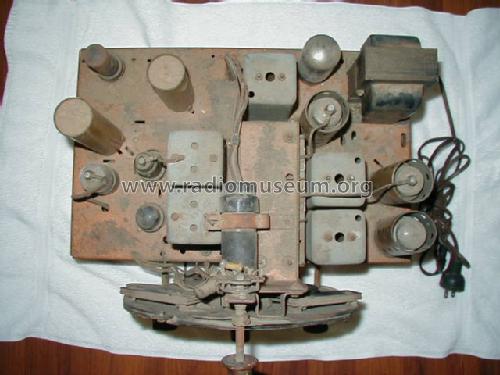
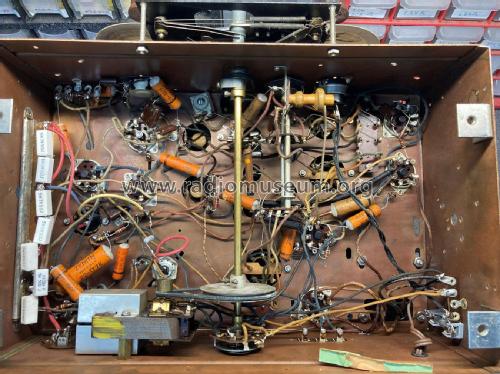
Gentlemen, First let me apologize for my delinquent response. I have been quite ill with bronchitis and the associated fun that goes with it. With the advice of Emilio, Giovanni and Nikolaus the Zenith is now in operating condition. The following is a synopsis of the repair. C16 was indeed defective and replaced. I did check the output transformer which was within spec. I also found that C21 was connected to ground on both ends, C3 from the grid of the 6K7 (RF) was missing, R10 had been replaced with an incorrect value, there was a 10Meg 2 Watt resistor in parallel with R16 at the 250 and 30 ohm taps as well as more cold solder joints than I can remember. I also found several instances where terminal strips had so much solder that they bridged to make connection with other components. I consider myself amateur when it comes to radio but who ever worked on this prior to me had no business attempting repairs. Again, my sincere thanks for your help and patience in the last two months. Kind regards, Joe Rose |
|
Ernst Erb
04.Jan.09 |
11
Dear Joe |
|
Joe Rose
05.Jan.09 |
12
I have taken several photos of the the Zenith 9S262 for your review. I will be happy to provide any information I have regarding this receiver. I do know that the chassis (5905) was built in 1938 and was installed in to at least seven models. These radios are all 9 tube design as indicated in the prefix... e.g., 9S204, 9S232, 9S242, 9S244, 9S262, 9S263, and 9S264. To the best of my knowledge the difference in these models is the variety of cabinetry which includes consoles, chairsides and large table models. As you may know, these are commonly known as "shutter dial" or "robot dial" radios due to the motorized tuning and the shutter action of the dial mechanism evident when changing bands. I have seen a video on utube.com of the dial mechanism in operation which is quite interesting if you haven't seen one in use. I have taken photos of the moving speaker enclosure for your review. I think the intent is to move the "Acoustic Adapter" in or out to vary the speaker baffle characteristics to produce a change in sound. This is accomplished via a rod through the speaker core, upset on the cone side and treaded on the back to mount a knob. Additionally, the chassis of these radios is isolated from the cabinet via rubber isolators at the chassis mounting bolts as to limit low frequency vibration of the receiver.
I intend to upload additional photos from my collection of which I try to maintain at around 100 receivers give or take a few. At this point all new additions to this collection need prior approval from my wife of 30+ years. I do however, have an out building (barn) where I can keep a few which are not allowed to play with the others. Like the Hallicrafters S-36A and the Hammalund HQ110A. They may be ugly to her but, to me they sensitive creatures with lots of knobs and switches. Enough already, please use and distribute these pictures as you wish. Respectfully, Joe Rose
|
|
Joe Rose
05.Jan.09 |
13
I have experienced problems uploading photos. Is there information on the site to explain this process?
Thanks, J. Rose |
|
Emilio Ciardiello
06.Jan.09 |
14
Try this: http://www.radiomuseum.org/forum/howto_upload_your_pictures_to_a_radio_model_page.html Regards, Emilio |
|
Joe Rose
07.Jan.09 |
15
Tom and Emilio, With your assistance I think I have the photo upload issue in control. I have (or will attempt) uploading some photos of the speaker adapter operation. I will also be adding some pics of other radios I have not seen on RM.org. Best regards, Joe |