|
Early British 10-cm reflex klystrons required to operate quite high resonator voltage, well over 1000 V. At the end of 1941 Western Electric introduced its 707A, capable of operating at 300 V resonator. This result was made possible using grids connected to the resonator discs, to enhance the interaction between electron beam and the resonator itself. In December 1941 TRE asked for a British klystron capable of operation under 300 V, with the same supply voltage of the IF strips.
The design was run by EMI with the assistance of the Signal School in Bristol, the same involved in the development of the Sutton tube. The work led to the development of a very advanced family of low-profile klystrons for the 10-cm range, capable of delivering more than 100 mW at 250 V. The grids were made by very tin tapes of corrugated molybdenum, 1 mm wide, randomly folded and brazed to the inner rims of the copper discs.
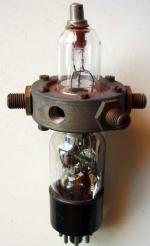
10AL1 was an experimental intermediate type, similar as per shape to 707A but with grids of molybdenum tape, likely assembled at Bristol, to test the proper operation of the new design.
The design steps of the KR6 family is well described by Callick. This is one of the experimental tubes built at the Bristol Signal School
|