High Fidelity Pre-Amplifier
Mullard Wireless, London (see also Mullard Radio Valve)
- País
- Gran Bretaña (GB)
- Fabricante / Marca
- Mullard Wireless, London (see also Mullard Radio Valve)
- Año
- 1955
- Categoría
- Kit (Partes con instruciones) o Solo Instrucciones
- Radiomuseum.org ID
- 283570


From Manufactures manual
Haga clic en la miniatura esquemática para solicitarlo como documento gratuito.
- Numero de valvulas
- 3
- Principio principal
- Amplificador de Audio
- Gama de ondas
- - no hay
- Tensión de funcionamiento
- Alimentado desde otro equipo o aparato principal. / DC: 250 & AC: 6.3 Volt
- Altavoz
- - Este modelo usa amplificador externo de B.F.
- Material
- Metálico
- de Radiomuseum.org
- Modelo: High Fidelity Pre-Amplifier - Mullard Wireless, London see
- Forma
- Chasis (tambien de autoradio)
- Anotaciones
-
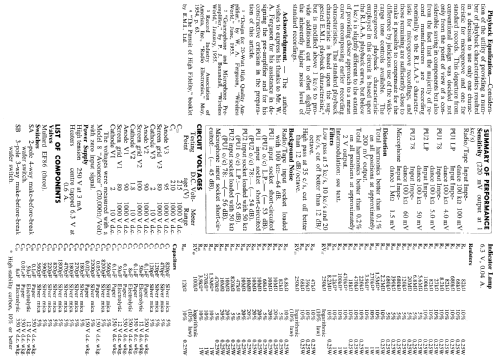
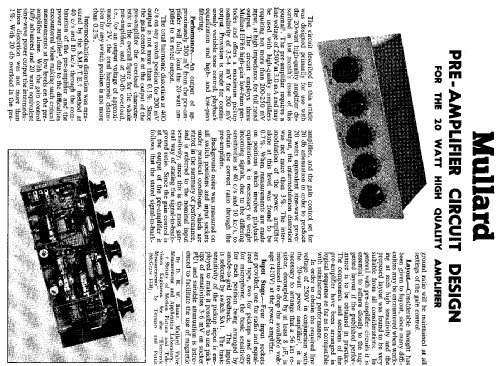
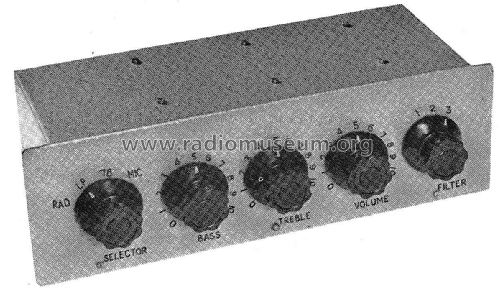
Three‑stage EF86 pre‑amplifier published by Mullard as the companion circuit to the Mullard 20‑watt high‑quality amplifier. The design provides the required gain, equalisation and filtering for magnetic and crystal pickups, radio/tape sources, and low‑level microphones. Output is approximately 200 mV at low impedance, matching the input sensitivity of the Mullard 20‑watt amplifier, including the later 1960 version.
The pre‑amplifier is powered from the main amplifier’s HT rail via a 250 V / 3 mA feed obtained through a 56 kΩ dropping resistor and decoupling capacitor.
Circuit Summary
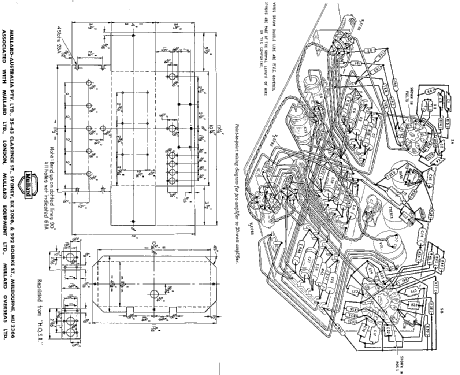
V1 provides high‑gain input amplification with anode‑to‑grid feedback to set sensitivities for each input. V2 restores gain lost in the passive tone network and maintains low source impedance for the tone controls. V3 incorporates the high‑pass and low‑pass filters and drives the output gain control. The design maintains stable overload behaviour, with distortion remaining low even at 20 dB overload.Performance
- THD: < 0.1% at 200 mV output; < 0.2% at 2 V (20 dB overload)
- Intermodulation: ≤ 1% at 20 W system output
- Noise: –53 to –64 dB depending on input loading
- Frequency Response: Flat to 20 kHz in filter position 3; response shaped by tone controls and selectable filters
Technical Notes
Inputs:
- Microphone (1.5 mV, 1 MΩ)
- Radio/Tape (100 mV, 100 kΩ)
- PU1 LP (4 mV), PU1 78 (5 mV)
- PU2 LP (50 mV), PU2 78 (60 mV)
Tone Controls:
- Passive Baxandall bass and treble network using logarithmic‑law potentiometers (10% law), with “flat” near mid‑rotation
Playback Equalisation:
- Microgroove (LP): RIAA‑based playback characteristic, with Mullard’s low‑frequency modification below 1 kHz to approximate earlier pre‑RIAA curves
- Standard (78): Based on EMI recommended characteristic, with additional HF cut to reduce surface noise
Filters:
- Low‑pass at 5 kHz, 10 kHz, or 20 kHz (flat)
- High‑pass (rumble) at 35 Hz, ≥12 dB/octave
Output:
- Low‑impedance feed via 100 kΩ log gain control; stable with up to 400 pF load (≈20 ft coax)
Power:
- 250 V at 3 mA HT; 6.3 V heater supply (0.6 A total)
Examples of commercial Pre-amplifiers
- Mencionado en
- Wireless World (The), London (WW, 79) (July 1955, p.326-329)
- Autor
- Modelo creado por Gary Cowans. Ver en "Modificar Ficha" los participantes posteriores.
- Otros modelos
-
Donde encontrará 151 modelos, 121 con imágenes y 65 con esquemas.
Ir al listado general de Mullard Wireless, London (see also Mullard Radio Valve)