Monita Mini MR-2
Seiwa Corporation; Tokyo
- Country
- Japan
- Manufacturer / Brand
- Seiwa Corporation; Tokyo
- Year
- 1970 ??
- Category
- Commercial Receiver (may include amateur bands)
- Radiomuseum.org ID
- 229078


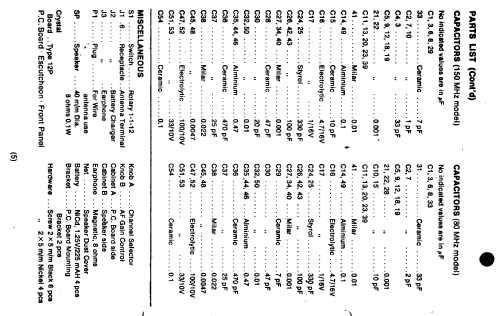

Photo credit Barry Anderson.

Photo credit Barry Anderson.

Photo credit Barry Anderson.

Photo credit Barry Anderson.

Original aus Beschreibung
Click on the schematic thumbnail to request the schematic as a free document.
- Number of Transistors
- 19
- Semiconductors
- Main principle
- Superhet, double/triple conversion; ZF/IF 10700/455 kHz
- Wave bands
- Wave Bands given in the notes.
- Power type and voltage
- Batteries / addl. power jack / 5 Volt
- Loudspeaker
- - only for Earphone!
- Material
- Bakelite or Plastics (type unknown)
- from Radiomuseum.org
- Model: Monita Mini MR-2 - Seiwa Corporation; Tokyo
- Shape
- Very small Portable or Pocket-Set (Handheld) < 8 inch.
- Dimensions (WHD)
- 69 x 112 x 33 mm / 2.7 x 4.4 x 1.3 inch
- Notes
-
Compact crystal‑controlled FM receiver using a double‑superheterodyne circuit. The MR‑2 is factory‑aligned to provide a usable crystal‑exchange bandwidth of 4 MHz (or 2 MHz for the 80 MHz version) without noticeable loss of sensitivity or need for re‑tuning. Twelve channels are available via an internal crystal bank and front‑panel selector.
“Available frequency bandwidth… 4 MHz… you may interchange crystals without remarkable drop of sensitivity and without re‑tuning.”
Powered by an internal 5 V NiCd pack (4 × 1.25 V) charged through the rear jack; a full charge requires approx. 14 hours, after which charging current automatically stops.
“This NiCd Battery… four unit of 1.25 Volt… approximately 14 hours… charging current automatically stops…”
Uses HC‑25/U series‑resonant crystals with < 2 mW drive and ESR < 25 Ω. Frequency tolerance is ±15 ppm at 25 °C and ±30 ppm from –10 °C to +60 °C.
“Type of holder: HC‑25/U… Drive Level: Less than 2 mW… E.S.R.: Less than 25 ohms.”
Front‑panel controls include ON/OFF‑Volume, 12‑position channel selector, antenna jack and earphone jack. Squelch is factory‑set and located internally.
“Squelch control is located inside… Adjustment is already made at factory…”
Typical uses include sub‑receiver duties, cross‑band monitoring, and general service monitoring (commercial, fire, police, air/harbor control, paging, and group‑coordination roles).
“Monitoring of various types, including commercial, fire, police, air control, harbor control…”
Technical Data
Receiver circuit: Crystal‑controlled double superheterodyne (F3).
Frequency range: 80 MHz model 70–80 MHz (2 MHz max per unit); 150 MHz model 140–170 MHz (4 MHz max per unit).
Selectivity: 12 kHz at –6 dB; 24 kHz at –50 dB. Intermediate frequencies: 10.7 MHz (1st IF) and 455 kHz (2nd IF).
Frequency stability: ≤ ±0.002%.
Squelch sensitivity: –6 dB.
20 dB quieting sensitivity: 1 µV or less.
Spurious sensitivity: > –50 dB.
Audio output: 70 mW at 10% distortion.
Power source: 5 V NiCd pack (1.25 V × 4). Power drain: 6.5 mA (squelch on); approx. 3 days operation at 8 h/day on full charge.
Number of channels: 12.
Standard accessories: Wire antenna, earphone, AC charger (120 V or 220 V).
- Net weight (2.2 lb = 1 kg)
- 0.2 kg / 0 lb 7 oz (0.441 lb)
- Source of data
- -- Original-techn. papers.
- Author
- Model page created by Rudolf Müller. See "Data change" for further contributors.
- Other Models
-
Here you find 4 models, 2 with images and 1 with schematics for wireless sets etc. In French: TSF for Télégraphie sans fil.
All listed radios etc. from Seiwa Corporation; Tokyo