Stereo Amplifier 421
Armstrong Audio / Wireless & Television / Manufacturing; London
- Country
- Great Britain (UK)
- Manufacturer / Brand
- Armstrong Audio / Wireless & Television / Manufacturing; London
- Year
- 1967–1969
- Category
- Audio Amplifier or -mixer
- Radiomuseum.org ID
- 345195
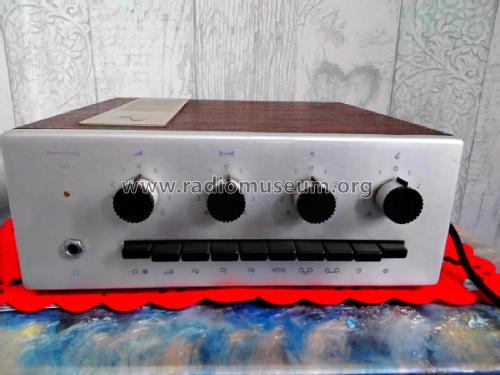
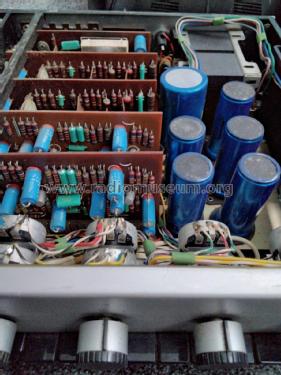
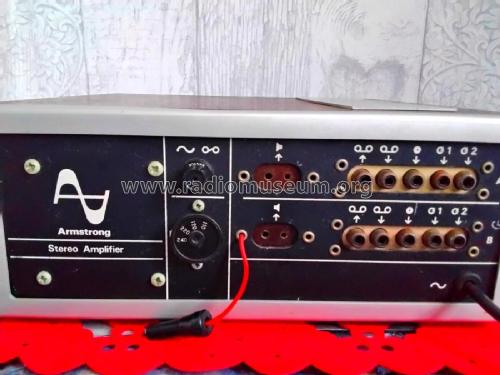
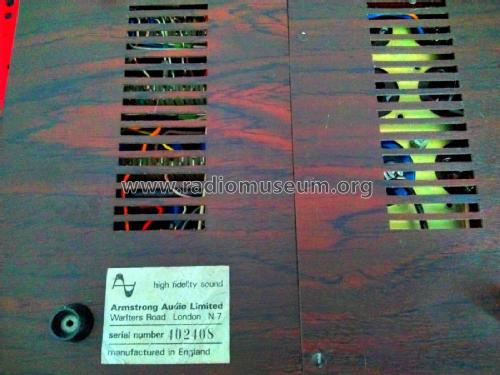

Wireless World May 1967, p. 251.
- Number of Transistors
- Semiconductors present.
- Semiconductors
- Main principle
- Audio-Amplification
- Wave bands
- - without
- Power type and voltage
- Alternating Current supply (AC) / 50-60 Hz, 105-125; 210-250 Volt
- Loudspeaker
- - This model requires external speaker(s).
- Power out
- 30 W (undistorted)
- Material
- Metal case
- from Radiomuseum.org
- Model: Stereo Amplifier 421 - Armstrong Audio / Wireless &
- Shape
- Book-shelf unit.
- Dimensions (WHD)
- 269 x 102 x 267 mm / 10.6 x 4 x 10.5 inch
- Notes
-
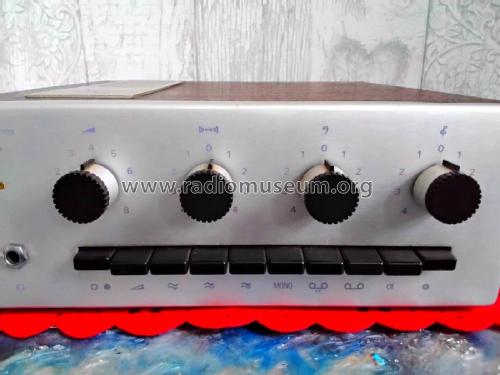
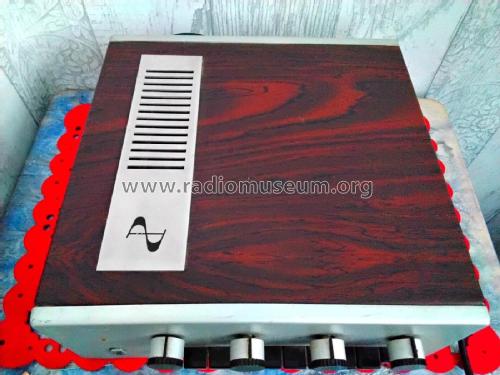
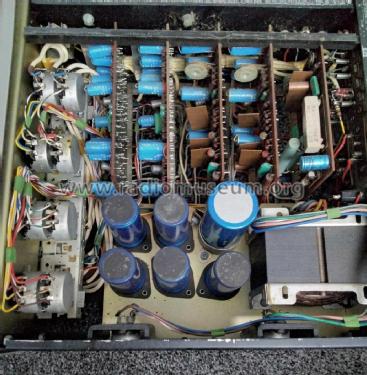
Introduced in 1967, the 400 Series represented Armstrong’s first line of fully transistorized (solid-state) Hi-Fi audio components. Styled by Philip Connor Design Associates, the series won a Design Council Award and featured a distinctive silver anodized aluminium fascia with purple lettering, set in a wooden cabinet with a ventilated top grille. Built on a modular chassis utilizing plug-in printed circuit boards with edge connectors, the audio amplifier section was built around the A.14 amplifier board employing Germanium output transistors. The line remained in production until roughly 1969 when it was superseded by the visually revised 500 Series.
Technical Description
- Chassis Construction: Modular plug-in PCB architecture using edge connectors for independent removal and servicing.
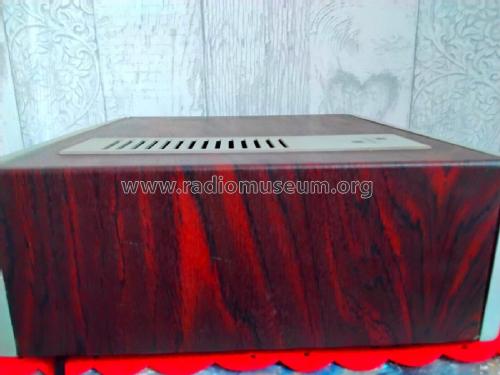
- Cabinet & Styling: Silver anodized brushed-aluminium front panel with distinct purple lettering and black control knobs; housed in a veneered wooden cabinet with a top-mounted ventilation grille.
- Circuit Topology: Fully transistorized, transformerless single-rail power supply. Utilizes the Armstrong A.14 amplifier board with a quasi-complementary output stage driven by Germanium AL102 power transistors and matching Germanium driver/pilot devices. (This circuit design was largely retained in the subsequent 500 Series, such as the Model 521).
- Power Output: 15 W RMS per channel continuous into 4–16 loads.
- Frequency Response: 20 Hz – 20 kHz (±1 dB).
- Distortion: THD < 0.5% at 1 kHz at rated 15 W output.
- Tone & Filter Controls:
- Bass: ±10 dB at 70 Hz
- Treble: ±10 dB at 10 kHz
- Switchable Low-pass (Treble) and High-pass (Rumble) audio filters
- Inputs: Magnetic Disc (Gram/Pickup), Radio (Tuner), and Tape.
Remarks / Notes
The standalone 421 Stereo Amplifier chassis/board design forms the core audio amplification stage used across the integrated receiver models in this series (Models 425 and 426).Series Model Lineup:
- 421: Integrated Stereo Amplifier
- 423: AM/FM (VHF/MW/LW) Tuner
- 424: FM (VHF) Tuner
- 425: FM (VHF) Receiver (Tuner-Amplifier)
- 426: AM/FM (VHF/MW/LW) Receiver (Tuner-Amplifier)
- Net weight (2.2 lb = 1 kg)
- 5.7 kg / 12 lb 8.9 oz (12.555 lb)
- Price in first year of sale
- 42.75 £
- Mentioned in
- Wireless World (The), London (WW, 79) (May 1967, p. 251.)
- Literature/Schematics (1)
- Wireless World (The), London (WW, 79) (Sep 1967, p. Ad 74.)
- Author
- Model page created by Stefano Ricupero. See "Data change" for further contributors.
- Other Models
-
Here you find 27 models, 25 with images and 9 with schematics for wireless sets etc. In French: TSF for Télégraphie sans fil.
All listed radios etc. from Armstrong Audio / Wireless & Television / Manufacturing; London