
7077

|
|
|||||||||||||||||||||||||||||||||||||||||



|
Hits: 2739 Replies: 5
7.5 GHz bandwidth claim not substantiated by the data sheet
|
|
|
Peter Holzleitner
04.Jul.25 |
1
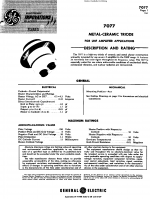
The statement amplifier for frequencies up to 7.5 GHz is not substantiated by the data sheet. Could this be a misunderstanding based on the 7.5 MHz bandwidth specified there for a 450 MHz amplifier? |
|
Otmar Jung
04.Jul.25 |
2
Vielen Dank für den Hinweis, die Daten sind jetzt geändert. |
|
Michael Watterson
04.Jul.25 |
3
See also tube 7486. I'd thought only TWTs worked as amps up to 7.5GHz, for thermonic devices. But maybe these do go that high? I've not read the data sheet, as it won't load, but found it elsewhere DOCTSF n° 88974 The GE datasheet elsewhere (doctsf) has typical 450 MHz 450 mW and 1200 MHz 300 mW, which is more believable for the capacitances and construction. Basically a 1960s update of the glass acorn. Specifies a minimum of 200 mW at 1200 MHz as an oscillator undfer special performance tests. |
|
Michael Watterson
04.Jul.25 |
4
The parent device of this family seems to be the 6BY4, a planar UHF triode from 1955. |
|
Michael Watterson
04.Jul.25 |
5
See also the British micropup, also maded by RCA in the 1940s. Here is the NT99, but some worked to over 900 MHz. Rather higher power and made obsolete for Radar by Magetrons. |
|
Emilio Ciardiello
19.Jul.25 |
6
Hello Michael, 7486 was similar to 7077, same size, shape and interelectrode capacitance values. The only appreciable difference was in that the 7077 was proposed as signal amplifier while the 7486 was intended as oscillator or RF power amplifier and tested for pulse operation at 1.2 GHz. The GE type selection table in the TPD-6101 catalog of ceramic tubes and modules specifies 7.5 GHz as maximum frequency for both types even if the 7486 data sheet specifies its operation as oscillator at 1200 MHz. Emilio |
End of forum contributions about this tube
| Data Compliance | More Information |