Radio-Katalog, Röhren, Halbleiter etc.
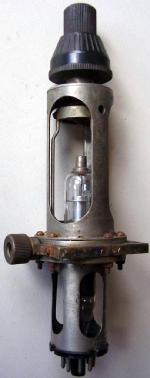
CV87
|
|
|
|
|
| Typ: |
Reflex Klystron |
| |
Ca. 1925 bis 1945, aber äusserst selten, weil
weniger als 100 Röhren produziert wurden. **** |
|
| Identisch mit |
CV87
= KRN2
|
| Ähnliche |
Austauschbar, kleine Unterschiede mögl.
CV323
|
|
Nachfolger
|
CV129
CV224
|
| Sockel |
Oktalsockel K8A, IO (USA ab 1935)
|
| Anwender |
Radar |
| Heizung |
Uf 4 Volt / If 1.4 Ampere / Indirekt |
| Beschreibung |
The first British klystron capable of operating as local oscillator in X-band radar receivers was developed by EMI in close collaboration with the Clarendon Laboratory. The approach was to scale-down the design of the already working S-band ‘Sutton tube’, using the same copper to glass seal technique to connect the external cavity. To prevent unacceptable dielectric losses in the glass wall, the klystron was designed to operate with the harmonic resonator proposed by Blumlein at EMI. The cavity was modified to operate in a three-quarter mode, with nodal circle in correspondence of the glass wall and an antinodal circle between the glass wall and the outer wall of the cavity.
According to Callick, early samples of KRN2 were available for experimentation by March 1941, followed by a production of about 100 units, many of which supplied to TRE for their X-band developmental sets.
Operated with 10 W in input at 1500 V and -425 V reflector, they gave about 100 mW in output over a range tunable from 3.05 to 3.45 cm. The klystron used a differential screw tuning mechanism. It was approved as CV87.
|
Abmessungen (BHT)
inkl. Stifte/Spitzli |
x 165 x mm / x 6.50 x inch |
| Literatur |
Taschenbuch zum Röhren-Codex 1948/49
-- Original-techn. papers. Callick, Metres to Microwave
|
|
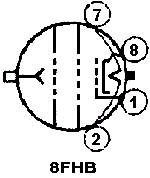 CV87: Manufacturer's Literature
Emilio Ciardiello
|
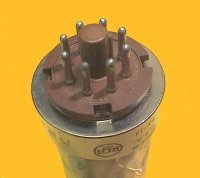
Just Qvigstad
|
|
Sammlung von
|
|
|
|
[rmxtube-ge, noindex]
| Datenkonformität |
Mehr Informationen |
|
|
|