|
|
||||
| Year: 1955 / 1956 | Type: Radio or Tuner | ||||
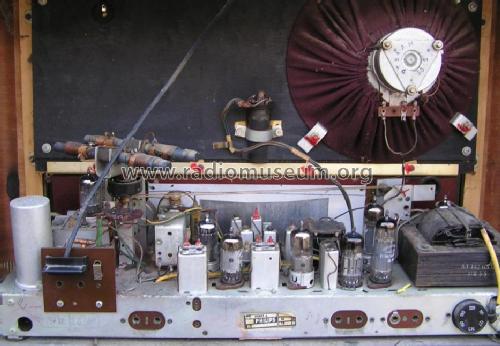
| Valves / Tubes | 9: ECC85 ECH81 EF89 EF85 EM80 EABC80 EL84 UL41 EZ80 |
|---|
| Principle | Super-Heterodyne (Super in general); IF-Freq. 452/10,7 kHz; 2 AF-stage(s) |
|---|---|
| Tuned circuits | 6 AM circuit(s); 10 FM-circuit(s) |
| Wave bands | Broadcast, Long Wave, Short Wave plus FM. |
| Power type and voltage | Alternating Current supply (AC) / 110, 127, 145, 160, 180, 220 Volt |
| Loudspeaker/pwr.out | Permanent Magnet Dynamic (PDyn) Loudspeaker (moving coil) / 6 W / Ø 21 cm = 8.3 inch |
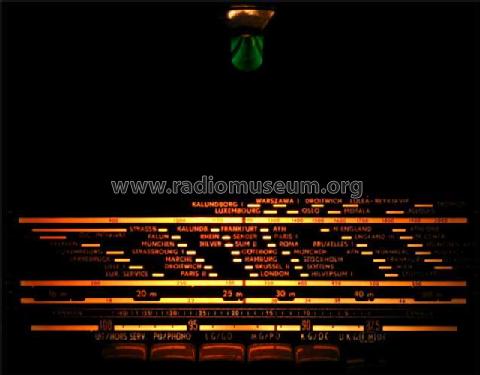
| from Radiomuseum.org | Model: BX553A |
| Material | Wooden case |
| Shape | Tablemodel with Push Buttons. |
| Dimensions (WHD) | 625 x 413 x 235 mm / 24.6 x 16.3 x 9.3 inch |
| Notes | loudspeaker Philips 9754AM 800 ohms |
This model was suggested by Iven Müller.
All listed radios etc. from Philips; - Eindhoven; Netherlands
Here you find 2163 models, 1839 with images and 1424 with schematics.
Collection of John Hupse (NL)
Collection of William Tremblett (TW)
|
Hits: 585 Replies: 0
philips: BX553A (BX 553 A);
|
|
|
Paul Pinyot
13.Jan.10 post_type = 2 |
1
Gentlemen, Where may I find an alignment procedure for this radio chassis? Thanks, Paul. |
|
Carlos Alves
13.Jan.10 post_type = 1 |
2
Hi Paul, If you wanted i send to you the service manual but in Dutch. Best Regards Carlos Alves |
|
Mario Coelho
13.Jan.10 post_type = 1 |
3
Dear Paul You can also see it in radiotechniek. Mario |
|
Paul Pinyot
14.Jan.10 post_type = 1 |
4
Mario and Carlos, I downloaded a service manual from Radiotechniek and yes it is in Dutch. I think I can manage through the alignment since there are plenty of similar looking words. I may come back to this board to ask help with certain sections. I usually have difficulty with FM alignments just after the ~10.7 MHz IF steps. Looking at the section for the UL41 tube function is interesting too. I find the cross cultural/language differences quite challenging, intriguing and enriching. Paul. |
|
Paul Pinyot
14.Jan.10 post_type = 2 |
5
Would some one please check my translation? I scanned the Dutch version printed from a PDF with an HP scanner and saved to a Microsoft RTF file. Cleaned up the type. Then processed the text with Google Translate ( http://translate.google.com/#nl|en| ). Please put corrections in a different color (i.e., RED). This is what I got: Het afregelen van de ontvanger A.M. gedeelte Algemeen
The adjusting of the receiver
A.m. part Overall Volumeregelaar op maximum.
Voltmeter via trimtransformator aansluiten op extra luidspreker aansluitingen.
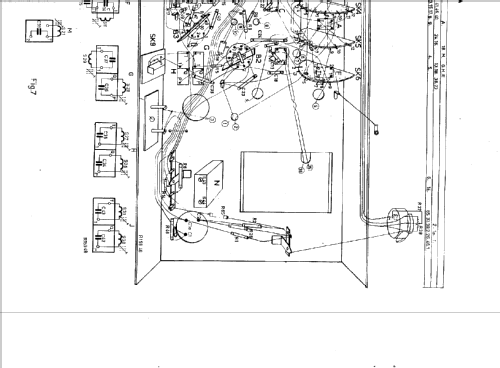
Trimpunt 1 ligt Geheel limke op stationsschaal.
Trimpunt 2 ligt juist rechts naast trimpunt 1.
Trimpunt 3 ligt gcheel reckts op de stationsschaal.
Kernen der M.F. bantfilters zo ver mogelijk uitdraaien.
Indien niet anders aangegeven, worden de signalen via een normale kunstantenne aan de antenne bussen toegevoerd.
Volume control at maximum.
Voltmeter using trim transformer connect additional speaker ¬ closures. Trim Point 1 is far left on drive level Trim Point 2 is just right trim point 1.
Trim Point 3 is completely right on the station level. nuclei of M.F. band filters as far as possible from turning.
Unless otherwise indicated, the signals through a normal aerial art buses supplied to the antenna. (Insert IF table).
M.F. Sper- en zuigkringen
M.F. Lock- and suction circuits
Kernen van S11 en S12 zover mogelijk uitdraaien.
S6-S6a kortsluiten.
Cores S11 and S12 where possible printouts (turning).
S6-S6a short-circuit.
1. Stationswijzer instellen op trimpunt 3.
2. Signaal van 452 KHz toevoeren via normale kunstantenne aan antannebus.
3. S11 trimmen op maximum output.
4. Kern van S11, 1/4 slag doordraaien.
5. S12 trimmen op minimum output.
6. S11 natrimmen.
1. Station Finder trim set point 3 (station pointer to trim set point 3).
2. 452 KHz signal from feeding through mainstream art antenna antannebus. 3. S11 trimming at maximum output. 4. The core of S11, 1/4 turn by turn. 5. S12 trimming output at minimum. 6. S11 after trimming. (Note on top of table )
Verbinding van antannebus naar punt 11 SK-ant. losnemen.
Connection of antannebus SK-ant to section 11. disconnecting
(Insert HF Oscillator Table)
(Table Heading).
Golfbereik Trimpunt Signaal Afregelen Indicatie Aanwijzing
Signal Point Golf Range Trim adjusting Designation Indicator
(Note on bottom of table )
Verbinding van antannebus naar punt 11 SK-ant. Weer aanbrengen.
Connection of antannebus SK-ant to section 11. Reapplied
F.M. gedaelte
Het afregelen met behulp van een F.M. Service oscillator
Algemeen
F.M. part
The adjusting using a F.M. Service oscillator Overall Volume regelaar op maximum.
Hoge tonen regelaar op maximum hoog.
Lage tonen regelaar op maximum laag.
Diodevoltmeter via een weerstand van 0,1 M ohm aansluiten over R23.
Voltmeter via trimtransformator aansluiten over extra luidspreker aansluitingen.
Tijdens het afregelen dient de uitgangsspanning van de Service oscillator dusdanig te worden ingesteld dat de diodevoltmeter (D. V.) een spanning van ca. 8 Volt aanwijst.
De signalen zijn gemoduleerd met 500 Hz, zwaai 22 ½ KHz.
Volume control at maximum.
Treble control on high ceiling. Bass control on maximum layer. Diode Voltmeter using a 0.1 M ohm resistor R23 to connect. Voltmeter using trim to connect additional speaker transformer connections. While adjusting, the output voltage of the oscillator Service to be established so that the diode voltmeter (DV) a voltage of about 8 designates Volt. The signals are modulated at 500 Hz, sweep 22 ½ KHz. Kernen van S21, S27, S31 en S36 zover mogelijt uitdraaien.
Cores S21, S27, S31 and S36 far as possible from turning.
S44 en S44 kortsluiten. (under chassis). S43 and S44 shorting. (under chassis).
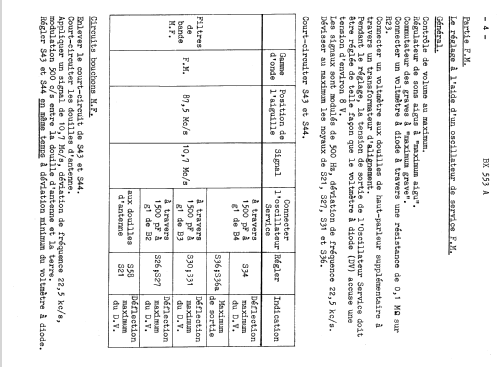
(Insert M.F. band Table here.)
M.F. sperkringen
Kortsluiting van S43 en S44 opheffen. (Under chassis).
Antennebussen kortsluiten.
Signaal van 10.7 MHz zwaai 22 KHz, mod. 500 Hz toevoeren tussen antennebus en aarde.
S43 en S44 gelijktijdig aftrimmen op minimum aanwijzing D.V.
M.F. barrier circles
Remove Short circuit of S43 and S44. (Under chassis). Antenna Buses shorting. Signal from 10.7 MHz 22 KHz swing, mod. 500 Hz feeding between aerial and earth. S43 and S44 simultaneously trimming minimum indication on DV (Insert FM oscillator table).
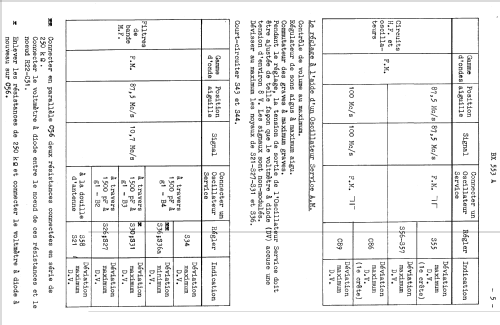
(Insert table from top of page 5)
Het afregelen met behulp van een A.M. Service Oscillator
Volume regelaar op maximum.
Hoge tonen regelaar op max, Hoog.
Lage tonen regelaar op max, laag.
Ti jdens het afregelen dient de ui tgangsspanning van de Service oscillator dusdanig te worden ingesteld dat de diode voltmeter (D. V.) een spanning van ca, 8 Volt aanwijst.
De signalen zijn ongemoduleerd.
The adjusting using a a.m. Service Oscillator
Volume control at maximum. Treble control on max, High. Bass control on max, low. While adjusting, the output of the voltage. Service oscillator to be set so that the diode voltmeter (DV) a voltage of about 8 designates Volt. The signals are unmodulated. Kernen van S21, S27, S31 en S36 zover mogelijk uitdraaien.
Cores S21, S27, S31 and S36 where possible printouts far as possible from turning
S43 en S44 kortsluiten
S43 and S44 short-circuit
(Insert FM band table).
** Sluit parallel aan C67 twee in serie gesehakslde weerstanden van 250k ohm.
Sluit de D. V. aan tussen het knooppunt van doze weerstanden en het knooppunt R22, C51.
* Verwijder weerstanden van 250 k ohm en sluit de D.V. weer aan over C67.
** Connect parallel to C67 in series two 250k ohm resistors.
Connect the D. V. between the junction of resistors and the junction doze R22, C51. * Remove 250 k ohm resistors and connect the DV back to about C67. M.F. sperkringen
Kortsluiting S43 en S44 opheffen.
Antennebussen kortsluiten.
Ongemoduleerd signaal van 10.7 MHz toevoeren tussen antennebus en aarde.
S43 en S44 galijktijdig aftrimmen op minimum aanwijzing D.V.
M.F. barrier circles
Short circuit S43 and S44 removal. Antenna Buses shorting. Unmodulated signal of 10.7 MHz feeding between aerial and earth. S43 and S44 simultaneously trimming minimum indication on DV (Insert FM oscillator table).
Aandrijfsnaren
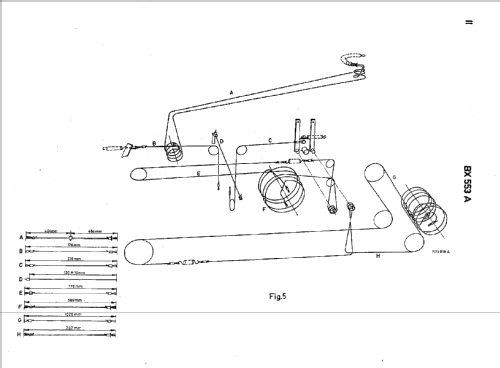
De lengte en de loop van de aandrijfsnaren zijn gegeven in fig. 5. De variabele condensatoren zijn hierbij in maximum stand getekend.
Driving Strings
Thelength and the course of the drive strings are given in figure 5. The variable capacitors are hereby signed in maximum position.
Aandrijfmechanisme
Bij het indrukken van de druktoets voor de F.M. ontvangst wordt het
aandrijfmechanisme van de A.M. afstemcondensator ontkoppeld en de
aandrijving voor de F.M. afstemcondensator ingeschakeld.
Op A.M en F.M. kan hierdoor due met hetzalfde bedienings organ
worden afgestemd.
Drive Mechanism
By pressing the push button for F.M. the host |
|
Dirk Taekels
14.Jan.10 post_type = 2 |
6
Hi Paul , I made corrections on your translation. Dirk
This is what I got:
Het afregelen van de ontvanger
A.M. gedeelte
Algemeen
The adjusting of the receiver
A.m. part Overall Volumeregelaar op maximum.
Voltmeter via trimtransformator aansluiten op extra luidspreker aansluitingen.
Trimpunt 1 ligt Geheel links op stationsschaal.
Trimpunt 2 ligt juist rechts naast trimpunt 1.
Trimpunt 3 ligt geheel rechts op de stationsschaal.
Kernen der M.F. bandfilters zo ver mogelijk uitdraaien.
Indien niet anders aangegeven, worden de signalen via een normale kunstantenne aan de antenne bussen toegevoerd.
Volume control at maximum.
Voltmeter using trim transformer connect to the additional speaker connections. Trim Point 1as far as possible to the left side of the dial scale Trim Point 2 is just on the right side of trim point 1.(just near the point 1)
Trim Point 3 is completely on the right side of the dial scale. Turn the ferrite cores of the bandfilters as far as possible ccw.
Unless otherwise indicated, the signals are applied through a normal aerial on the the antenna connections. (Insert IF table).
M.F. Sper- en zuigkringen
M.F. barrier- and suction circuits
Kernen van S11 en S12 zover mogelijk uitdraaien.
S6-S6a kortsluiten.
Turn cores S11 and S12 as far as possible ccw .
S6-S6a shorting.
1. Stationswijzer instellen op trimpunt 3.
2. Signaal van 452 KHz toevoeren via normale kunstantenne aan antannebus.
3. S11 trimmen op maximum output.
4. Kern van S11, 1/4 slag doordraaien.
5. S12 trimmen op minimum output.
6. S11 natrimmen.
1. Set the dial scale to the Trim point 3 position.
2. Apply a 452 KHz signal to the antenna connections . 3. S11 trimming to have the maximum output. 4. Turn the core of S11, 1/4 turn cw. 5. S12 trimming to have the minimum output. 6. Readjust S11! (Note on top of table )
Verbinding van antannebus naar punt 11 SK-ant. losnemen.
Disconnect antenna-connection to point 11t.
(Insert HF Oscillator Table)
(Table Heading).
Golfbereik Trimpunt Signaal Afregelen Indicatie Aanwijzing
Wave range Indication of adjusting of Trimpoint signal
(Note on bottom of table )
Verbinding van antannebus naar punt 11 SK-ant. Weer aanbrengen.
Reconnect antenna-connection to point 11.
F.M. gedeelte
Het afregelen met behulp van een F.M. Service oscillator
Algemeen
F.M. part
The adjusting using a F.M. Service oscillator General Volume regelaar op maximum.
Hoge tonen regelaar op maximum hoog.
Lage tonen regelaar op maximum laag.
Diodevoltmeter via een weerstand van 0,1 M ohm aansluiten over R23.
Voltmeter via trimtransformator aansluiten over extra luidspreker aansluitingen.
Tijdens het afregelen dient de uitgangsspanning van de Service oscillator dusdanig te worden ingesteld dat de diodevoltmeter (D. V.) een spanning van ca. 8 Volt aanwijst.
De signalen zijn gemoduleerd met 500 Hz, zwaai 22 ½ KHz.
Volume control at maximum.
Treble control on high ceiling. Bass control on maximum layer. Diode Voltmeter using a 0.1 M ohm resistor parallel on R23. Connect the Voltmeter using a trimtransformer to the additional speakerconnections. While adjusting, the output voltage of the Service oscillator has to be adjusted so that the diode voltmeter (DV) read a voltage of about 8 Volt. The signals are modulated at 500 Hz, sweep 22 ½ KHz. Kernen van S21, S27, S31 en S36 zover mogelijk uitdraaien.
Turn cores S21, S27, S31 and S36 as far as possible ccw.
S44 en S44 kortsluiten. (under chassis). S43 and S44 shorting. (under chassis).
(Insert M.F. band Table here.)
M.F. sperkringen
Kortsluiting van S43 en S44 opheffen. (Under chassis).
Antennebussen kortsluiten.
Signaal van 10.7 MHz zwaai 22 KHz, mod. 500 Hz toevoeren tussen antennebus en aarde.
S43 en S44 gelijktijdig aftrimmen op minimum aanwijzing D.V.
M.F. barrier circuits
Remove Short circuit of S43 and S44. (Under chassis). Antenna Buses shorting. Signal from 10.7 MHz 22 KHz swing, mod. 500 Hz feeding between aerial and earth. S43 and S44 simultaneously trimming to have a minimum indication on DV (Insert FM oscillator table).
(Insert table from top of page 5)
Het afregelen met behulp van een A.M. Service Oscillator
Volume regelaar op maximum.
Hoge tonen regelaar op max, Hoog.
Lage tonen regelaar op max, laag.
Ti jdens het afregelen dient de ui tgangsspanning van de Service oscillator dusdanig te worden ingesteld dat de diode voltmeter (D. V.) een spanning van ca, 8 Volt aanwijst.
De signalen zijn ongemoduleerd.
The adjusting by using a a.m. Service Oscillator
Volume control at maximum. Treble control on max, High. Bass control on max, low. While adjusting, the output voltage of the Service oscillator has to be set so that the diode voltmeter (DV) read a voltage of about 8 Volt. The signals are unmodulated. Kernen van S21, S27, S31 en S36 zover mogelijk uitdraaien.
Turn cores S21, S27, S31 and S36 as far as possible ccw.
S43 en S44 kortsluiten
S43 and S44 shorting.
(Insert FM band table).
** Sluit parallel aan C67 twee in serie geschakelde weerstanden van 250k ohm.
Sluit de D. V. aan tussen het knooppunt van deze weerstanden en het knooppunt R22, C51.
* Verwijder weerstanden van 250 k ohm en sluit de D.V. weer aan over C67.
** Connect parallel to C67 two resistors of 250K ohm (who are in series) .
Connect the D. V. between the junction of this two resistors and the junction of R22, C51. * Remove the 250 k ohm resistors and reconnect the DV back to C67. M.F. sperkringen
Kortsluiting S43 en S44 opheffen.
Antennebussen kortsluiten.
Ongemoduleerd signaal van 10.7 MHz toevoeren tussen antennebus en aarde.
S43 en S44 galijktijdig aftrimmen op minimum aanwijzing D.V.
M.F. barrier circles
Remove shorting on circuit S43 and S44. Antenna Buses shorting. Apply an unmodulated signal of 10.7 MHz signal between aerial and earth. S43 and S44 simultaneously trimming to have a minimum indication on DV (Insert FM oscillator table).
Aandrijfsnaren
De lengte en de loop van de aandrijfsnaren zijn gegeven in fig. 5. De variabele condensatoren zijn hierbij in maximum stand getekend.
Driving Strings
The length and the course of the drive strings are given in figure 5. The variable capacitors are hereby signed in maximum position.
Aandrijfmechanisme
Bij het indrukken van de druktoets voor de F.M. ontvangst wordt het
aandrijfmechanisme van de A.M. afstemcondensator ontkoppeld en de
aandrijving voor de F.M. afstemcondensator ingeschakeld.
Op A.M en F.M. kan hierdoor met hetzelfde bedieningsorgaan
worden afgestemd.
Drive Mechanism
By pressing the push button for F.M. , the drive mechanism of the A.M. is decoupled while
the drive for F.M. is coupled . In this case the AM and the FM drive commands can be done using the same mechanism. |
|
Konrad Birkner
20.Jan.10 post_type = 1 |
7
I think the matter is finished and therefore no question any longer. |
|
Paul Pinyot
26.Jan.10 post_type = 1 |
8
Dirk, I completed the alignment tonight. Your translation corrections were a big help. Thanks again for the corrections. Now I need to find a Bass control poteniometer. Paul. |
|
Hits: 2063 Replies: 0
philips: BX553A; Kombination UL41/EL84
|
|
|
Franz-Josef Haffner
04.Jul.05 post_type = 0 |
1
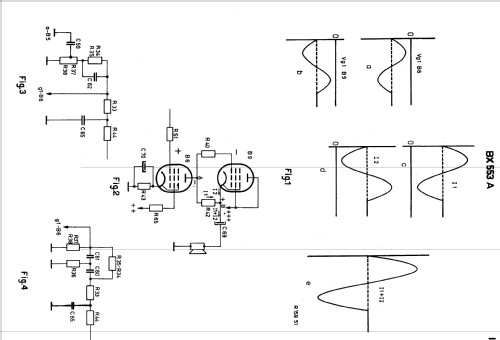
Hallo, ich habe dieses Gerät erworben in einem sehr schönen Zustand. Aber ich verstehe nicht warum hier eine UL41 mit einer EL84 kombiniert wird. Was rechtfertigt den Aufwand einer extra Heizwicklung für die UL41? Gruß Franz-Josef |
|
Henning Oelkers
04.Jul.05 post_type = 0 |
2
Hallo, Herr Haffner, mein Röhrenhandbuch ist zwar im Keller, aber ich meine, das der Grund für diese Eigenart die Überschreitung der zulässigen Spannung zwischen Heizfaden und Kathode ( bei E Type ) ist. Immerhin müsste dort ja ca. 250 Volt zulässig sein. Da Röhren der P und U Serie hier i. A. höhere Werte haben, dürfte das der Grund dafür sein. Falls nötig, kann ich demnächst nochmal genau nachsehen. Gruß aus Berlin, Henning Oelkers |
|
Georg Schön
04.Jul.05 post_type = 0 |
3
Hr. Haffner, nicht nur die Verwendung einer U-Röhre ist merkwürdig, auch daß die eine Rimlock-Röhre ist, scheint mir für das Jahr 1955 bemerkenswert. Ich sehe das so: - da die Kathode der UL41 einen weiten Spannungsbereich im Betrieb überstreicht und direkt mit dem Hochohm- lautsprecherausgang verbunden ist, wurde auf jeden Fall eine separate (nicht geerdete) Heizwicklung benötigt. - U-Röhren haben im Allgemeinen höhere Isolationswiderstände Faden-Kathode. - UL41 waren in großen Mengen vorhanden, wurden im Konzern "wie sauer Bier" angeboten. Grüße Georg Schön |
|
Hans M. Knoll
04.Jul.05 post_type = 0 |
4
Hallo Herr Haffner, Das ist in meiner Vorstellung so: In der „Mitte„ der eisenlosen Endstufe also am LSpr. liegen doch die 1/ 2 Ub die aber mit der Wechselspannung der 800 Ohm Lautsprecher ueberlagert sind. Nehmen Sie ihr Scope und schauen Sie hin! Das wichtigste ist aber, die UL41 (und die UL84) sowie die spaetere EL86 laufen noch bis unter 100 Volt Ua. und Ug2 gut. Die EL84 aber bei weitem nicht. Die hat doch im Normalfall immer um die 200Volt oder mehr als Ug2. Alle bis auf die EL84 kommen noch bei 50Volt und hohen Stroemen gut zurecht. Deshalb finden Sie als Laengsroehre in Stabi.- Netzteilen nie eine EL84 Die ganze Problematik der Eisenlosen Endstufen will ich hier nicht ausbreiten. Es gibt dazu viele Berichte in der Fachpresse. Gruesse von Hans M. Knoll Wie ich sehe, bin ich schon der Dritte. Na ja wenigsten kein Widerspruch. |
|
Franz-Josef Haffner
04.Jul.05 post_type = 0 |
5
danke Herr Oelkers, Herr Schön und Herr Knoll. Die Begründung mit den Spannungsverhältnissen und den Eigenarten der eisenlosen Endstufe war einleuchtend. Gruß Franz-Josef |
|
Georg Schön
04.Jul.05 post_type = 0 |
6
Hallo Hr. Knoll, da muß man neidlos den Meister anerkennen! Wäre es eigentlich auch mit einer UL84 gegangen? Ob es die schon gab, als das Radio entworfen wurde? Grüße Georg Schön |
|
Hans M. Knoll
04.Jul.05 post_type = 0 |
7
Hallo Herr Schoen, Danke!! siehe Post 4 Das wichtigste ist aber, die UL41 (und die UL84) sowie die spaetere EL86 laufen noch bis unter 100 Volt Ua. und Ug2 gut. Die UL84 war im gleichen Jahr schon imEinsatz- Der Saturn 653/4E/3D hat noch die EL84_UL41, die Capella 753/4E/3D schon EL84_ UL84. Das Geraet von H.Haffner ist aber Europa - Export "BX" dort gelten auch Marktregeln. Aber das mit dem Ueberhang ist so falsch nicht, auch bei Philips gab es Abschreibungen von Maschinen. Freundlichst, Hans M Knoll Nachtrag fuer H. Pflug. Das Problem war nicht eine Lizenz, sondern die Lautsprecher mit einer Schwingspule von 800 Ohm . Gegen einer 5 oder 8 Ohm Spule ein grosser Aufwand an Koennen und Fertigungstechnik. Die Schwingspule hat mehrere Lagen. Standard war max. zwei Lagen. MfG Knoll |
|
Joe Sousa
19.Jan.10 post_type = 1 |
8
Liebe Radio Freunde, Vielleicht findest du dies post in English interessant: Tube or NPN quasi-complementary Totem-Pole Grüße, |