Tempus (Time Signal Receiver)
Badman, W. J. & Co.; Weston-Super-Mare
- Country
- Great Britain (UK)
- Manufacturer / Brand
- Badman, W. J. & Co.; Weston-Super-Mare
- Year
- 1913
- Category
- Detector-Radio (Crystal or diode, without tubes/transistors)
- Radiomuseum.org ID
- 125978

- Main principle
- Crystal or Solid State Detector
- Tuned circuits
- 1 AM circuit(s)
- Wave bands
- Long Wave and/or Very Low Frequency (VLF).
- Power type and voltage
- No Power needed
- Loudspeaker
- - For headphones or amp.
- Material
- Wooden case
- from Radiomuseum.org
- Model: Tempus - Badman, W. J. & Co.; Weston-
- Shape
- Tablemodel, Box - most often with Lid (NOT slant panel).
- Notes
-
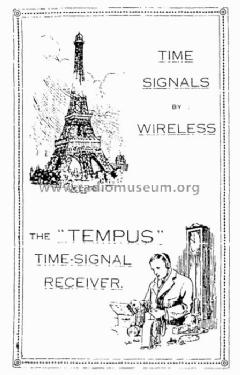
The Tempus was a specialized crystal radio receiver produced by W. J. Badman & Co. It was specifically designed for watchmakers, jewelers, and horologists to obtain exact standard time by tuning into long-wave time signals transmitted twice daily from the Eiffel Tower (FL) in Paris (at 10:44 AM/PM) and Nauen (POZ) in Germany (at 11:55 AM/PM).
The Tempus was developed and sold simultaneously alongside the Horophone (manufactured by the Synchronome Co. / Frank Hope-Jones). Both sets filled the vital niche of providing precise time calibration (accurate to within one-tenth of a second) in the era before automated telephone speaking clocks ("TIM") or BBC broadcast time pips.
Technical Features & Variants
Integrated Test Buzzer:
Because crystal detectors required precise mechanical adjustment, the Tempus incorporated a built-in battery-operated test buzzer. Acting as a weak, local untuned spark transmitter, the buzzer allowed the operator to find a sensitive point on the cat's whisker before the scheduled time transmission began.Cabinet & Model Options:
- Type A ("Workshop Model"): Box-like wooden cabinet with hinged lid, batteries, and testing buzzer. Dimensions: 8 x 7 x 5.5 inches. Price: £5.
- Type B ("De Luxe Model"): Larger cabinet with internal headphone storage space. Dimensions: 8.5 x 8 x 7 inches. Price: £7 (or 10 shillings extra over Type A).
Accessories:
Optional Brown’s 4000-ohm double headphones were offered for £2 17s 6d (or a single earphone for £1 5s 0d).Documentation:
Supplied with an original instruction manual containing graphical dot-and-dash code charts for decoding Eiffel Tower and Nauen time signals, alongside Postmaster General (PMG) regulations for single-wire (100 ft) or twin-wire (140 ft) outdoor aerial installations.
- Price in first year of sale
- 5.00 £
- Mentioned in
- Bulletin of the British Vintage Wireless Society (BVWS, 73) (Westman, Eric. "A Somerset Wireless Pioneer" Vol. 17, No. 5, October 1992, p. 65).)
- Author
- Model page created by Konrad Birkner † 12.08.2014. See "Data change" for further contributors.
- Other Models
-
Here you find 1 models, 1 with images and 0 with schematics for wireless sets etc. In French: TSF for Télégraphie sans fil.
All listed radios etc. from Badman, W. J. & Co.; Weston-Super-Mare