Tempus (Time Signal Receiver)
Badman, W. J. & Co.; Weston-Super-Mare
- Pays
- Royaume Uni
- Fabricant / Marque
- Badman, W. J. & Co.; Weston-Super-Mare
- Année
- 1913
- Catégorie
- Poste à détecteur (diode ou cristal, pas de lampes)
- Radiomuseum.org ID
- 125978

- Principe général
- Détecteur à galène ou semi-conducteur
- Circuits accordés
- 1 Circuits MA (AM)
- Gammes d'ondes
- GO et Très Grandes Ondes
- Tension / type courant
- Pas d'alimentation nécessaire
- Haut-parleur
- - Pour casque ou amplificateur BF
- Matière
- Boitier en bois
- De Radiomuseum.org
- Modèle: Tempus - Badman, W. J. & Co.; Weston-
- Forme
- Modèle de table boitier avec vouvercle
- Remarques
-
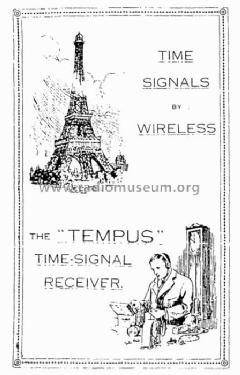
The Tempus was a specialized crystal radio receiver produced by W. J. Badman & Co. It was specifically designed for watchmakers, jewelers, and horologists to obtain exact standard time by tuning into long-wave time signals transmitted twice daily from the Eiffel Tower (FL) in Paris (at 10:44 AM/PM) and Nauen (POZ) in Germany (at 11:55 AM/PM).
The Tempus was developed and sold simultaneously alongside the Horophone (manufactured by the Synchronome Co. / Frank Hope-Jones). Both sets filled the vital niche of providing precise time calibration (accurate to within one-tenth of a second) in the era before automated telephone speaking clocks ("TIM") or BBC broadcast time pips.
Technical Features & Variants
Integrated Test Buzzer:
Because crystal detectors required precise mechanical adjustment, the Tempus incorporated a built-in battery-operated test buzzer. Acting as a weak, local untuned spark transmitter, the buzzer allowed the operator to find a sensitive point on the cat's whisker before the scheduled time transmission began.Cabinet & Model Options:
- Type A ("Workshop Model"): Box-like wooden cabinet with hinged lid, batteries, and testing buzzer. Dimensions: 8 x 7 x 5.5 inches. Price: £5.
- Type B ("De Luxe Model"): Larger cabinet with internal headphone storage space. Dimensions: 8.5 x 8 x 7 inches. Price: £7 (or 10 shillings extra over Type A).
Accessories:
Optional Brown’s 4000-ohm double headphones were offered for £2 17s 6d (or a single earphone for £1 5s 0d).Documentation:
Supplied with an original instruction manual containing graphical dot-and-dash code charts for decoding Eiffel Tower and Nauen time signals, alongside Postmaster General (PMG) regulations for single-wire (100 ft) or twin-wire (140 ft) outdoor aerial installations.
- Prix de mise sur le marché
- 5.00 £
- Littérature
- Bulletin of the British Vintage Wireless Society (BVWS, 73) (Westman, Eric. "A Somerset Wireless Pioneer" Vol. 17, No. 5, October 1992, p. 65).)
- Auteur
- Modèle crée par Konrad Birkner † 12.08.2014. Voir les propositions de modification pour les contributeurs supplémentaires.
- D'autres Modèles
-
Vous pourrez trouver sous ce lien 1 modèles d'appareils, 1 avec des images et 0 avec des schémas.
Tous les appareils de Badman, W. J. & Co.; Weston-Super-Mare