Spade Responder
DeForest Radio Telephone & Telegraph Co. (De Forest); New York
- Produttore / Marca
- DeForest Radio Telephone & Telegraph Co. (De Forest); New York
- Anno
- 1905/1906
- Categoria
- Modulo per radio pre 1926 (non un particolare, nessun tasto)
- Radiomuseum.org ID
- 364100
-
- alternative name: Lee De Forest Mfg.
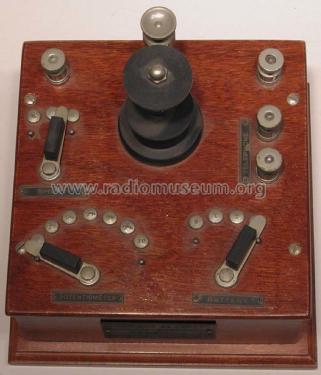
- Principio generale
- Rivelazione a galena / semi-conducteur
- Gamme d'onda
- - senza
- Tensioni di funzionamento
- Batterie a secco
- Altoparlante
- - - Nessuna uscita audio.
- Materiali
- Vari materiali
- Radiomuseum.org
- Modello: Spade Responder - DeForest Radio Telephone &
- Forma
- Soprammobile a cassapanca o cassetta, solitamente con coperchio (NON a leggio)
- Dimensioni (LxAxP)
- 6.5 x 7.25 x 7.25 inch / 165 x 184 x 184 mm
- Annotazioni
-
The de Forest responder, also known as an electrolytic detector, was developed by Lee de Forest in the early 1900s. It was designed to enhance the detection of radio signals, building on earlier technologies like the coherer and the magnetic detector. The responder utilized a piece of platinum leaf sealed in glass and dipped into a dilute acid solution, which allowed for more sensitive signal detection compared to previous methods.
De Forest had founded his American deForest Wireless Telegraph Company in 1901 to manufacture wireless telegraph equipment and to operate wireless stations, and he continued to experiment with equipment already covered by patents.
This is the deForest "Responder" (which he first called a "spade" or "sponder") is perhaps the best example known of deForest’s several costly attempts to work around Marconi and Fessenden patents.
The deForest Responder was a variant of Reginald Fessenden’s patented electrolytic, or liquid barretter, detector. Marconi’s mid-1890s coherer detector had been the only detector in use until 1902, when the Marconi Company introduced their magnetic detector. Fessenden subsequently invented an electrolytic detector, which used a platinum wire sealed in a glass rod and dipped into a dilute acid solution. Early in 1903, deForest developed an electrolytic detector that used a piece of platinum leaf sealed into glass, which he called a "spade electrode," and later a "responder," for commercial use. De Forest’s spade detector soon became standard equipment not only in de Forest wireless stations but in receivers supplied to the U.S. Navy.
Fessenden sued deForest for patent infringement, and in 1906, after a three-year court battle, won an injunction to stop de Forest from manufacturing and/or using the spade electrolytic detector. DeForest substituted a less sensitive carborundum crystal (a patent held by H. H. Dunwoody, an officer of the de Forest Company) for the spade detector, but as it turned out, the electrolytic detector was soon replaced by more sensitive and stable galena, silicon, and other crystal detectors.
- Autore
- Modello inviato da Alan Larsen. Utilizzare "Proponi modifica" per inviare ulteriori dati.
- Altri modelli
-
In questo link sono elencati 163 modelli, di cui 138 con immagini e 16 con schemi.
Elenco delle radio e altri apparecchi della DeForest Radio Telephone & Telegraph Co. (De Forest); New York