Mouse FM Scan Radio
Unknown - CUSTOM BUILT: China
- Country
- People's Republic of China
- Manufacturer / Brand
- Unknown - CUSTOM BUILT: China
- Year
- 2000 ??
- Category
- Broadcast Receiver - or past WW2 Tuner
- Radiomuseum.org ID
- 367815
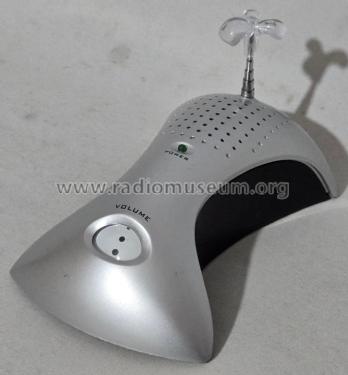
Foto de Francisco Martins
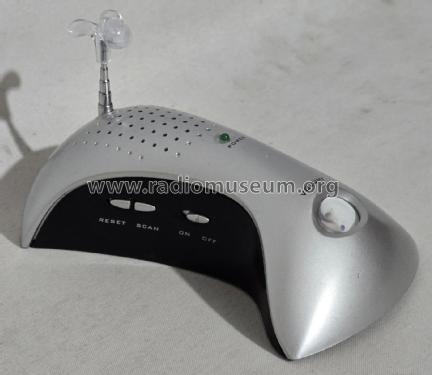
Foto de Francisco Martins
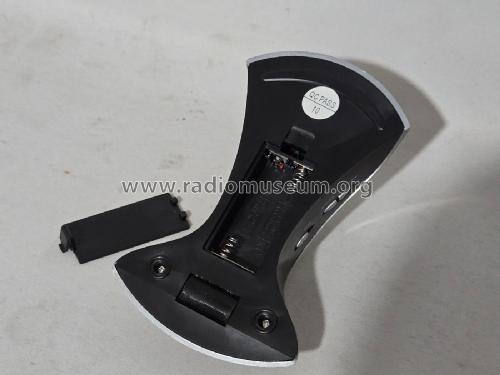
Foto de Francisco Martins
- Number of Transistors
- Semiconductors present.
- Semiconductors
- Main principle
- FLL, Frequency-locked loop (not PLL)
- Wave bands
- FM Broadcast Band Only
- Details
- Scanner - broadcast only (+FM)
- Power type and voltage
- Dry Batteries / AAA: 2 x 1.5 Volt
- Loudspeaker
- Permanent Magnet Dynamic (PDyn) Loudspeaker (moving coil) / Ø 3 cm = 1.2 inch
- Material
- Plastics (no bakelite or catalin)
- from Radiomuseum.org
- Model: Mouse FM Scan Radio - Unknown - CUSTOM BUILT: China
- Shape
- Design Radio or Novelty / Gadget - fancy or unusual shape.
- Dimensions (WHD)
- 80 x 45 x 130 mm / 3.1 x 1.8 x 5.1 inch
- Notes
-
This device is an example of a novelty portable FM receiver, popular in the late 1990s and early 2000s for its distinctive "computer mouse" inspired ergonomic silhouette.
Design & Construction
- Housing: The chassis is constructed from injection-molded ABS plastic with a metallic silver finish. It features a high-arched, curved profile designed to mimic a peripheral device.
- Acoustics: The top surface integrates a perforated circular grille, housing a small internal permanent magnet dynamic speaker.
- Antenna System: It utilizes a top-mounted, clear acrylic "flower" or "propeller" head attached to a multi-section telescopic mast for VHF signal reception.
Controls & Interface
- Volume Adjustment: A prominent circular thumbwheel/potentiometer is located at the lower front of the device for power switching and analog gain control.
- Status Indicator: A single green LED provides visual confirmation of the power state.
- Tuning Mechanism: Uses an auto-scan functionality for frequency selection across the standard FM band.
- Net weight (2.2 lb = 1 kg)
- 0.1 kg / 0 lb 3.5 oz (0.22 lb)
- Author
- Model page created by Francisco Martins. See "Data change" for further contributors.
- Other Models
-
Here you find 553 models, 532 with images and 32 with schematics for wireless sets etc. In French: TSF for Télégraphie sans fil.
All listed radios etc. from Unknown - CUSTOM BUILT: China