

History of the manufacturer
Admiral (brand) Continental Radio & Television Co.; Chicago, IL
Both will display your name after an officer has activated your content, and will be displayed under «Further details ...» plus the text also in the forum.
| Name: | Admiral (brand) Continental Radio & Television Co.; Chicago, IL (USA) | |||
| alternative name: |
 |
|||
| Brand: | Globe Trotter || Marshall || Oriole || Radiomaster || Slagle || Sunbeam || Wondertone | |||
| Abbreviation: | admiral | |||
| Products: | Model types Others Brand | |||
| Summary: |
Admiral (brand) Continental Radio & Television Co. Tubes were made for the company in the1940's and for many years later. |
|||
| Founded: | 1924 | |||
| Closed: | 1979 | |||
| Documents about this manufacturer/brand |
|
|||
| History: |
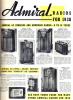
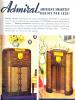
Admiral is the brand of Continental Radio & Television Corporation, 3800W. Cortland Street, Chicago, Illinois, USA bzw. Admiral Corporation at the same address is the marketing company for the maker. A more detailled story:Ross Siragusa founded the Admiral Corp. during the Depression and transformed it from a small radio and phonograph company into one of the leading makers of televisions, audio products and home appliances.In 1924, Siragusa had developed an earlier company, Transformer Corp. of America, which grew quickly by selling battery chargers for radios. But by 1929, the Depression caused Siragusa's company to go out of business. Undaunted, he turned to manufacturing radios. To get some start-up cash, Siragusa sold his automobile and home furnishings, and in 1934, created a new company, the Continental Radio and Television Corp., which is known most for its brand Admiral. Growth exploded with the arrival of contracts for military electronics during World War II; afterward, Siragusa steered Admiral into television. A pioneering TV brand, it became one of the top three in sales and was one of the first to produce color sets. In 1951, Admiral sold five million television sets, but then came a downturn. Disputes simmered over the regulatory framework for color television, and a new excise tax left manufacturers with huge inventories. By discounting its television sets and increasing its promotion of home appliances, Admiral survived for a while. But during an industry shakeout, with profits falling, the company was sold to Rockwell International Corp., which later pulled it out of the TV business. |
| Country | Year | Name | 1st Tube | Notes |
|---|---|---|---|---|
| USA | 60 | Transistor Radio Battery | 9 Volt Transistor Battery. | |
| USA | 36 | 134 Ch = 8AU | 6A7 | See mod. 133 for details - also 8AU = same chassis. |
| USA | 36 | 133 Ch = 8 AU | 6A7 | 150 - 350 kHz, 535 - 1730 kHz, 2350 - 7100 kHz plus 6 pushbuttons for short wave bands. Pu... |
| USA | 50 | 6T11 Ch= 5B1 | 12SA7 | Admiral Table Top AM 5 Tube Radio Model 6T11 Chassis 5B1. Power Consumption 30 Watts. |
| USA | 49 | RC 181 | ||
| USA | 49 | RC 182 | ||
| USA | 50 | RC 195 | ||
| USA | 50 | RC 196 | ||
| USA | 50 | RC 197 | ||
| USA | 46 | RC 200 | ||
| USA | 50 | RC 210 | ||
| USA | 50 | RC 211 |
Further details for this manufacturer by the members (rmfiorg):

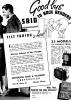
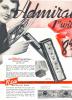
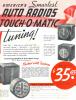




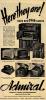





|
Hits: 4481 Replies: 0
Admiral Radios and important sources of information
|
|
|
Ernst Erb
15.Nov.11 |
1
Please see the next posts for data. There is the simple way to upload pictures - or this way to enhance or change data if possible - or even a step further to build up a framework similar to that I have done for the brand Lafayette.
We are building up a most complete reference work for radios and related items.
The most important source for that is primary information of the manufacturers
On the example of Admiral Radios, The whole process we do is an iteration process - but on a huge amount of data - a slow process. Already a few hundred "man years" of work are "invested"! In November 2011 we show only 115 thousand models with pictures and 101 thousand with schematics. Total is 200 thousand model pages (71 thousand for the USA - 30'600 with pictures and 47'700 with schematics). I'm sure we still miss worldwide many ten thousand models completely - yet.
For Admiral we show in November 2011 pre WW2 models: 273 and post war models: 1858 More analysis would be necessary to go on with this coding scheme for Admiral. It is a start. Everybody is welcome for a free membership who is able to help in the enhancement of model pages. We have enough papers to give an input. Interested can use the Contact Form. Corrections are very welcome, pictures naturally too. |
|
Hits: 7244 Replies: 0
Admiral coding in the early 60s on Y plus 4-digit models
|
|
|
Ernst Erb
23.Jul.08 |
1
In 1960/61 Admiral started a rather big range of small radios with or without clock or alarm clock with a coding starting with Y, followed by 4 number digits. But the start was with Y7.., Y8.. and Y9.. - an Y with 3 number digits. This range ended probably with Y86.. in 1963/64. In that period there is only a very few models which do not fit into this system. Each of the chassis family can have a different system of cabinet names and color scheme. |
End of forum contributions about this manufacturer/brand
| Data Compliance | More Information |