

History of the manufacturer
Philips Argentina, FAPESA, Miniwatt tubes; Buenos Aires
Both will display your name after an officer has activated your content, and will be displayed under «Further details ...» plus the text also in the forum.
| Name: | Philips Argentina, FAPESA, Miniwatt tubes; Buenos Aires (RA) |
| Abbreviation: | philips |
| Products: | Model types Tube manufacturer Tube wholesaler |
| Summary: |
Philips SAECO, 970 Moreno, Buenos Aires
Philips Argentina Sociedad Anónima de Lámparas Eléctricas y Radio
Fabrica Argentina de Productos Electronicos S.A. (FAPESA) FAPESA l.y.C., 2550 Av. Crovara, Tablada, Buenos Aires |
| Founded: | 1935 |
| Production: | 1934 - |
| History: |
Initially founded in 1923 as "Philips SAECO" (Philips South America Export Company) as a subsidiary of N.V. Philips, with an employee count of 350, the company commercialized electrical and electronic products that were imported from the Netherlands. In 1930 they began to import and market radio receivers. [1] A factory for tubes (see below) went to operation in 1934 at the address of 527 Herrera, Bueno Aires. The same year they commenced with the construction of radio receivers. Later that year, high-power broacast tubes were imported and the radio station LS8, Radio Sténtor, was built entirely by Philips. [1] Effective June 19, 1935, Philips SAECO became "Philips Argentina Sociedad Anónima de Lámparas Eléctricas y Radio" with director Cornelio G.H. van Luyt. [1] Around 1938, Philips continued expansion towards the interior of Argentina. In addition to the earliest productions in Federal Capitol and Greater Buenos Aires, branch operations were created in Rosario, Tucumán, Córdoba, Mendoza, Bahia Blanca, Concordia, Commodore Ribadavia and in Paraguay. [2] In 1941 Philips Argentina employed ca. 1,100 employees. [1] In 1944 a new property at the address of 3892 Vedia was aquired and a foundation stone with a time capsule in the form of an electric lamp was laid, and by September 1945 the factory concluded the move to the new address. At this point, Philips created the Franklin brand for the lower price market segment. [1] In 1946 (in the wake of the consequences of the Péron regime on national industries [MH]), Philips Argentina lost all contacts to the headquarters in the Netherlands. First they resorted to the import of material and soon it was necessary to improvise and e.g. recover sockets to continue making radio tubes. This led to the creation of the department of "Artículos Adicionales" (additional products) for the commercialization of refrigerators, ventilators, stoves, antennas, amplifiiers etc. They participated actively in the development of the ball-point pen or "Ball Point". [2] In 1951 Philips imported 4,000 television sets from the Netherlands, and the successful sales lead to their own TV production in the mid-50s. [1] By 1959 Philips Argentina had 8 head offices across the country, with 15,000 sale locations for lamps, 2,500 sales offices for radio receivers, 2,000 locations for radio recivers, 1,800 stores for music records and 500 authorized service shops. [1] "Phonogram" and later "Poly Gram" label records were sold starting from the 1970s. [1] Electronic components were produced by F.A.P.E. S.A. (Fabrica Argentina de Productos Electronicos), founded by Philips in 1938, and operating on the premises of Philips on Herrera St. [1] Philips took control of the company SAIRA from Mr. Teodoro Prieto in 1939/1940 and FAPESA commenced with radio tube production under the Philips brand that same year. In 1961, FAPESA became independent and moved to a new plot of 36,000 sqm in the La Tablada county, enabling them to also produce the rest of the components needed by Philips. [1], [2] FAPESA changed its name to "Fabrica Austral de Productos Electronicos S.A" in March 1982 and production of TVs, VCRs and home appliances moved to Rio Grande (Tierra del Fuego). In 1990 the domestic appliance division was sold to Whirlpool. [1], [2] FAPESA remains a Phillips subsidiary at the location of 3892 Vedia, Buenos Aires, to date (2011). [3] Brands used were "Philips Miniwatt", "Fapesa", and "Fapesa Miniwatt", or simply "Miniwatt". The production of tubes included "Red Series", "Gold Series", miniature, noval and rimlock (called "Técnica A") types as well as CRTs with 90° and 110° deflection Transmitter tubes for broadcasting, the Navy, and for export were also built (e.g. TA18/100, PP05/25 and TA12/20). [1] The "Argenta" line of tubes was introduced in 1940 for the Argentine market. It was divided in two series, "U" for AC or DC sets (e.g. 13BC1U) and a "D" battery set line (e.g. 25AC1D). [1] Some of the Argenta tubes were labeled "Made in Holland", but received a type designation from those series. Sources:
|
| Country | Year | Name | 1st Tube | Notes |
|---|---|---|---|---|
| RA | 60 | 21CAL196U | PCC88 | Este televisor es similar al 21TAL195U pero con gabinete tipo consola. Channels VHF 2 to ... |
| RA | 45 | AL-544V | 6D8 | Philips Argentina AL544V. |
| RA | 61 | L3AL90-T | AF115 | Philips Argentina L3AL90-T; Onda media 517 a 1622 kHzOnda corta 5,9 a 12,1 MHz. |
| RA | 50 | Fapesa Receptor en kit 226 | EF41 | |
| RA | 50 | Fapesa Receptor en kit 111 | UCH42 | Utiliza juego de bobinas Lesam nº 92-A |
| RA | 37/38 | AL161 | EK2 | The radio has 6 bases for the European P8A tubes - 5 of which are receiving tubes; and the... |
| RA | 40 | AL5251H | UF9 | 5 KW - Bänder : 2,5 -7 MHZ; 9,2-10,5 MHz ; 10,7 - 12,5 MHz; 14,1 - 16,5 MHz; 17 - 22 MHz. ... |
| RA | 36 | 5RA | EK2 | |
| RA | 36 | 6RA | EF5 | |
| RA | 36 | 5RWAT | EK2 | |
| RA | 36/37 | 5RWAD | EK2 | The 5RWAD chassis uses the dual-gang tuning condenser; the 5RWAT chassis uses the 3-gang t... |
| RA | 36 | 6RWA | EF5 |
Further details for this manufacturer by the members (rmfiorg):
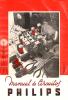
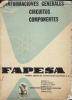
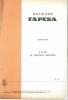
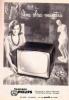
|
Hits: 3226 Replies: 0
APORTES HISTORICOS SOBRE FAPESA S.A.
|
|
|
Heriberto Tavella
10.Dec.07 |
1
Inicialmente la denominacion fue de FABRICA ARGENTINA DE PRODUCTOS ELECTRICOS S.A. con domicilio en calle Vedia 3892, que tambien era la sede de Philips de Argentina y posteriormente su nombre cambio a FABRICA ARGENTINA DE PRODUCTOS ELECTRONICOS S.A.I.C. |
|
Hits: 3392 Replies: 0
FAPESA S.A.
|
|
|
Heriberto Tavella
29.Nov.07 |
1 Un dato para la historia de esta importante firma instalada en el país, subsidiaria de la Philips, fabricante de valvulas electronicas, capacitores, T.R.C., valvulas de transmision, transistores, etc. Su planta industrial estuvo radicada en la Avda. Crovara, a pocas cuadras de la Av. General Paz, en el partido de La Matanza, Prov. de Buenos Aires.- |
|
Hits: 3511 Replies: 2
Historical Data - Philips Argentina 1935
|
|
|
Robert Sarbell † 22.3.22
18.Feb.06 |
1
History. It is born the 19 of June 1935 as a factory to produce different types of lamps, soon to extend their manufacturing and commercial activities. By those years an association with Radio Prieto had been concluded; and Philips had acquired the majority percentage of the actions of this society in which both made receivers. Additionally, Radio Prieto, had two radiotelephone stations "Prieto" and "Argentina Radio", that during a time were administered by Philips Argentina. Approaching 1938, Philips continued expansion towards the interior of Argentina. In addition to the earliest productions in Federal Capitol and Greater Buenos Aires, branch operations were born in Rosario, Tucumán, Córdoba, Mendoza, Bahia Blanca, Concordia, Commodore Ribadavia and even into the country of Paraguay. By 1938, the line of receivers had arrived at ten different models; in that year was born FAPESA (Maker in Argentina of Electrical Products), directing the manufacturing activity, while Philips was in charge of the commercial functions. During World War II, the direction of world-wide Philips was transferred to New York (New York). . . . . . . . . (by research technical data from member Robert Sarbell this supports the explanation for the use of several critical parts that were made in the United States, and are found in the production of the very early model AL161 radio. It also lends credibility to the implementation and use of some parts which may cause the earliest models to appear as though they were "home-made.) In 1946, Philips Argentina breaks free from all enemy contacts of their operations in Holland. First, they resorted to the import of material; soon it was necessary to improvise radio valves or to recover sockets to continue making incandescent lamps; the slogan was "not to stop", to maintain the production to "any cost". From Philips Argentina, the Additional Article Department was created there; thus it commercializes electrical refrigerators and to ice, ventilators, stoves to kerosene, antennas, equipment of amplification, etc. It participates actively in the development of the ball-point pen or "Ball Point", also was pioneering in indicators and signboards of neon. Note to the Administrators: The above historical data has been extracted from a current internet web site, and translated as accurately as possible. According to the web site, it is necessary to request permission from the Philips Argentina offices. Web site link will be provided upon further review. Respectfully, Robert P. Sarbell These revised historical comments reflect additional research by myself, and also some historical data inputs bty Senor Miquel Bravo from Cartagena, Spain. 12 June 2006 |
|
Omer Suleimanagich
19.Feb.06 |
2
This was a fantastic piece of research and restoration for this radio! Perhaps, with the knowledge we now have of Philips radios, maybe we could start some sort of "Philips" family tree on this site. I have a Philips based radio, Kosmaj '49 (Nikola Tesla, Belgarde), that was made right after the Yugoslavs parted with Stalin in '48. What is interesting, is that the construction uses more expensive materials than its Dutch counterpart, the BX373A. I believe the knobs are even Catalin! Perhaps there could be some discussion how some of the real socialist countries of the former Eastern bloc nations aquired licenses, etc. Philips has always been there when something good and new came about. Examples are, the compact cassette (an item they didn't even license but made into public domain) and the compact disc. In fact, I understand that Philips had a factory in South Africa too! |
|
Mark Hippenstiel
24.Jul.14 |
3
Dear colleagues, I have rewritten the whole page about the history of Philips with the help of the well-researched article of Mr. Santoro, published in Tube Collector 2009, to whom I express my thanks this way. I have to add that in view of the new data, and after a careful review of the company history page of Philips Argentina, there are some erroneous data in the previous post (and the previous version of this page) by Mr. Sarbell. The "breaking free of enemy contacts" is a misrepresentation of the company's own article, where they only state that "in 1946 they lost all contact to Holland" (verified for the archived website 2005 and 2006). I have added my own interpretation and marked it as such [MH]. The inclusion of Philips-owned FAPESA in the manufacturer page is new, as well as the listing of tubes with the different brands that have been employed by Philips/FAPESA. For further changes, please make sure to include a reference/source entry. I am sure there will be many, as such a complex matter can never be fully accurately described. Thank you.
Kind regards |
End of forum contributions about this manufacturer/brand
| Data Compliance | More Information |