Old radios, englishAlte Radios, deutschRadios antiguas, españolMusée de radio, francaisRadio antiche, italiano
Please click your language flag. Bitte Sprachflagge klicken.
Info - Help 

6E5

Country:  United States of America (USA)      Brand:  Common type USA 
  Tube type:  Mag. Eye, 1 shadow angle   Indication 
Tube ID = 2111
previous  |  next
Identical to 6E5 = VT-215 = 6Z-6E5 = UZ-6E5 = 6E5_Japan
Similar Tubes Other shape (e.g. bulb type):
 EZ-6E5-D; EZ-6E5-S
Normally replaceable-slightly different:
 6EG5
Other characteristic (electr. data):
 6G5; 6U5; 6Z-E3
Heater different:
 12Z-E6; 2E5
Other base:
 6E5GT; 6E5_DDR; 6X6; 6X6G; 6e5; 6e5s; Y63
Other base and other base diagram:
 1629
First Source (s) 27.Jun.1935 : Electron Tube Registration List
Predecessor Tubes Tune-A-Lite  
Successor Tubes 1939 6AF7   6AF7G   1629   6E5GT   EZ-6E5-S  

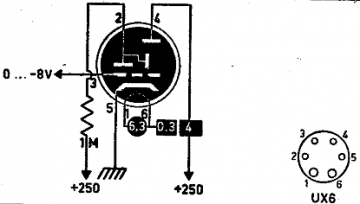
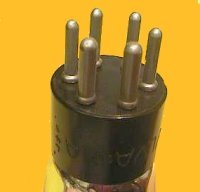
Base 6-Pin-Base U6A, old, USA (Codex=Ua)
Was used by Radio/TV-reception etc.
Filament Vf 6.3 Volts / If: 0.3 Ampere / -: Indirect / -: Parallel / series AC/DC /
Description The RCA tube 6E5 is the first Magic Eye, designed by Allen Balcom Du Mont (born Jan. 29, 1901 in Brooklyn NY, died Nov. 15, 1965 New York NY). Starting 1924 as an engineer for Westinghouse Lamp Company, Bloomfield, NJ, developing manufacturing and testing equipment for vacuum tubes. His first patent was: Aug. 21, 1925 serial no. 51,561 for "Mount for Radiotubes", patented July 9, 1929 as 1,719,968. He had achieved many more than 100 patents but for the Magic Eye the essential one was: Filed Sept. 18, 1934 Serial no. 744,498, patented June 20, 1939 as 2,163,256. Part of the patent text: "A cathode ray tube having beam producing means comprising a concentrating cylinder, an insulating cylinder having two holes there-through, a spacer connecting said insulating cylinder with said concentrating cylinder, a tungsten wire filament threaded through the holes in said insulating cylinder, a molybdenum wire secured to said tungsten filament, and an ocyde coating on the tip of said molybdenum wire. 2nd: A cathode ray tube having a fluorescent screen, means for producing a plurality of beams comrising a plurality of concentrating cylinders ..." See detailled article at www.radiomuseum.org

RCA followed with a 6G5, registered February 21, 1936. Still in 1936 RCA introduced the 2E5 and 2G5 electron-ray tubes so that also sets with 2.5 volt filaments (then actually outdated) could be equipped. 
Tube prices 0 Tube prices (visible for members only)
Literature Essential Characteristics, GE 1973   
Taschenbuch zum Röhren-Codex 1948/49   

  6e5_1.png
  Volume 1 Tubes DE MUIDERKRING
Greger Wärnå
6e5vonmazda_1.jpg
Herbert Odermatt (eig. Sammlung)
Herbert Odermatt + 26.Nov.05

 
476_5.png
Telefunken Werkstattbuch
Wolfgang Bauer

 
6e5_techdat01.png
RCA Tube Manual
Peter Hoddow

Usage in Models (calculation each 25th of the month)   5= 1935? ; 53= 1935 ; 10= 1936?? ; 18= 1936? ; 122= 1936 ; 6= 1937?? ; 5= 1937? ; 61= 1937 ; 17= 1938?? ; 6= 1938? ; 111= 1938 ; 10= 1939?? ; 5= 1939? ; 36= 1939 ; 7= 1940?? ; 3= 1940? ; 23= 1940 ; 3= 1941?? ; 2= 1941? ; 11= 1941 ; 2= 1942?? ; 3= 1942? ; 7= 1942 ; 3= 1943 ; 1= 1944? ; 1= 1944 ; 3= 1945?? ; 10= 1945? ; 3= 1945 ; 2= 1946?? ; 3= 1946? ; 15= 1946 ; 10= 1947?? ; 10= 1947? ; 24= 1947 ; 21= 1948?? ;
Number of Models at Radiomuseum.org with this tube (valve, valves, valvola, valvole, válvula, lampe):   966
Further Information for

6E5    

6E5 (6E5)  (21.03.2005) Robert Sarbell Clicks: 576     Replies: 0
Gentlemen, There is a reference to the Sylvania tube number 6E5 associated with the photo in tube id=2111. I respectfully and totally agree that in my Sylvania News Technical Section Vol. 6 No. 1, is the complete article with photograph of the NEW tube as it was introduced by Sylvania (in the United States) in January 1936. With all due respect, I have no knowledge as to when the USSR would have introduced their first "visible tuning indicator". The original Sylvania tube used the ST-12 shaped bulb with the small 6-pin base - as illustrated in the present tube id. The pinouts are identical to those of the Sylvania. I have recently completed two (2) adapter sockets which now allow me to test the "rimlock" tubes, and the european F8, G8, and Y8 base. I am presently conducting tests with an adapter I have created which will permit testing the European sidepin octal tubes (DIN 41565) on the Hickok 752A tester. I have discovered there are some limitations with current draw to properly test some of the full-wave rectifiers. Respectfully, Robert
 
You reach this tube or valve page from a search after clicking the "tubes" tab or by clicking a tube on a radio model page. You will find thousands of tubes or valves with interesting links. You even can look up radio models with a certain tube line up. [rmxtube-en]
  
rmXorg-09 About Radiomuseum.org | Contact | Press | Privacy | Copyright | Logos | send2friend 21NovX